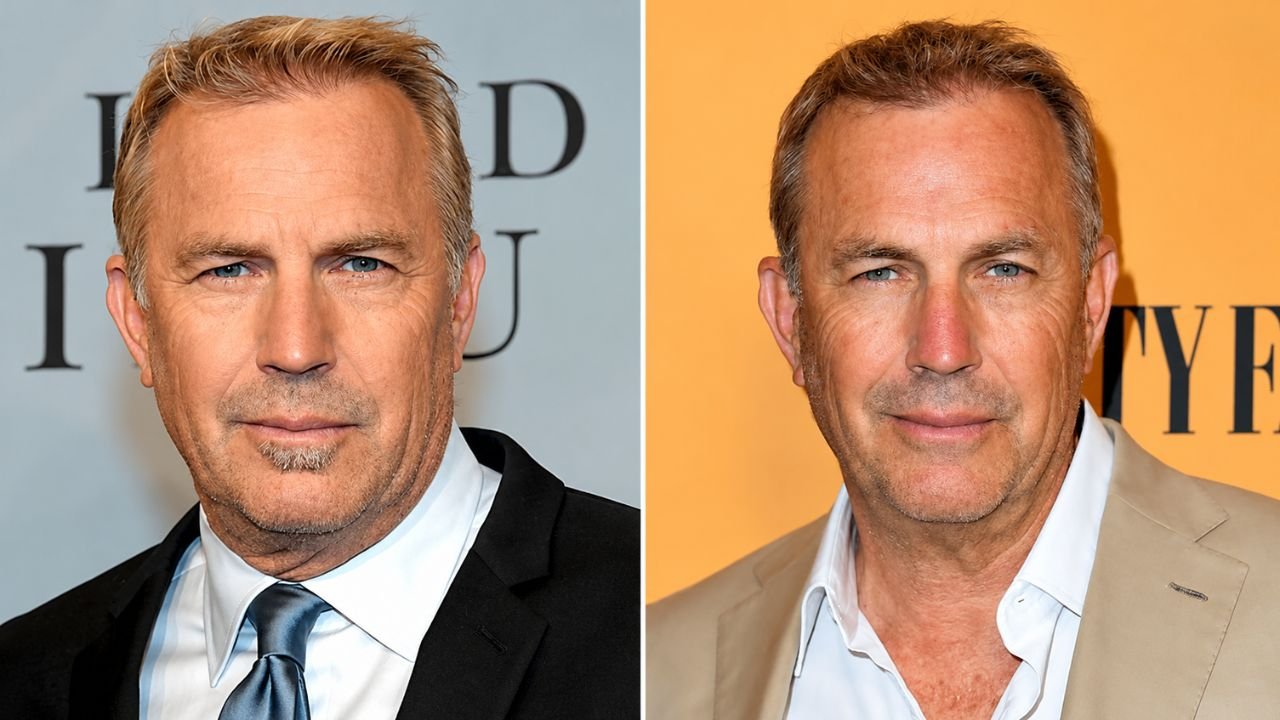
Kevin Costner has built a career that stretches across acting, directing, producing, writing, and music. Born in California in 1955, he eventually became one of Hollywood’s best-known leading men after a difficult start in the entertainment industry. His career includes Oscar-winning work, major box-office successes, television achievements, and ambitious Western projects. From Dances with Wolves and The Bodyguard to Yellowstone and Horizon: An American Saga, his work has repeatedly returned to stories about family, ambition, loyalty, and the American West.
Kevin Costner’s Early Life and Education
Kevin Michael Costner was born on January 18, 1955, in Lynwood, California, to Sharon Rae and William Costner. His father worked for an electric company, and the family’s moves during Costner’s childhood meant that he experienced different communities while growing up. Costner attended California State University, Fullerton, where he studied marketing and finance rather than beginning with formal training for a Hollywood career. Although acting was not his original professional plan, his interest in performing became stronger while he was in college.
After graduating, Costner began taking acting classes while working to support himself. His early years were far removed from the glamorous image associated with his later career, and he took different jobs while trying to find opportunities in the film industry. He eventually decided that acting was the career he wanted to pursue, even though there was no guarantee that he would succeed. His willingness to leave a more conventional career path became one of the first major decisions that shaped his future.
A memorable story from this period involves actor Richard Burton, whom Costner reportedly encountered during a flight. Burton encouraged the young actor to pursue his ambitions instead of abandoning them for a safer career. Costner later looked back on that meeting as an important moment in his decision to take acting seriously. The story fits the larger pattern of his early career because he had to keep pursuing opportunities despite repeated uncertainty.
Kevin Costner’s Difficult Start in Hollywood
Costner’s first years as an actor were not an immediate success. One of his early opportunities came with The Big Chill, directed by Lawrence Kasdan, but most of his scenes were removed from the final film. His character, Alex, was already dead when the main story began, so Costner’s appearance was limited to footage associated with the character’s funeral and memories. The experience could easily have become a dead end, but Kasdan later gave Costner a substantial role in another project.
That opportunity came with Silverado in 1985. The Western gave Costner a chance to show audiences the screen presence that would later become one of his trademarks. His performance helped him gain wider recognition and opened the door to larger roles during the second half of the 1980s. The period that followed transformed him from a struggling young actor into one of Hollywood’s most sought-after stars.
Costner’s breakthrough continued with films such as The Untouchables, No Way Out, Bull Durham, and Field of Dreams. These movies showed that he could work across crime dramas, thrillers, romantic sports stories, and emotional dramas without being limited to one type of character. His calm screen presence became particularly effective in roles involving determined but understated protagonists. By the end of the decade, Kevin Costner had established himself as a major Hollywood leading man.
Field of Dreams and the Rise of a Movie Star
Field of Dreams, released in 1989, became one of the films most closely associated with Costner’s career. He played Ray Kinsella, an Iowa farmer who hears a mysterious voice telling him to build a baseball field in his cornfield. The film combined sports, family, memory, and personal belief in a way that connected with audiences well beyond baseball fans. Costner’s restrained performance helped make the character believable without turning the unusual premise into something overly dramatic. His father in the film, John Kinsella, was portrayed by actor Dwier Brown, whose performance became one of the movie’s most memorable elements. Read our Dwier Brown biography to learn more about his acting career and life beyond Field of Dreams.
The success of Field of Dreams came during a period when Costner was becoming increasingly influential in Hollywood. He followed it with major projects that strengthened his reputation and expanded the kinds of stories in which he could appear. His performances during this period were often built around characters who were capable but not excessively theatrical. That style became one of the defining features of his work.
Dances with Wolves Changed Kevin Costner’s Career
Dances with Wolves became the most important filmmaking achievement of Kevin Costner’s early career. Released in 1990, the Western starred Costner as Lieutenant John Dunbar and also marked his debut as a major feature-film director. He took on substantial responsibility behind the camera while also carrying the leading role. The project demonstrated that his ambitions extended beyond acting.
The film became a major awards success and won seven Academy Awards, including Best Picture and Best Director for Costner. His achievement was particularly notable because directing and starring in such a large-scale Western required him to manage both the creative and practical demands of the production. The film established Costner as a filmmaker as well as a leading actor. It also reinforced the connection between his career and Western storytelling that would appear repeatedly in later projects.
Dances with Wolves remains central to discussions about Kevin Costner movies because it changed how Hollywood viewed him. He was no longer simply an actor who could carry a major production; he had demonstrated that he could direct one successfully as well. The film also gave him a long-term reputation for being willing to take creative risks. That reputation would later influence decisions surrounding projects such as Open Range and Horizon: An American Saga.
Kevin Costner’s Major Movies in the 1990s
The early 1990s continued Costner’s run of major films. He appeared in JFK, playing prosecutor Jim Garrison in Oliver Stone’s historical political thriller, and starred opposite Whitney Houston in The Bodyguard. The latter became one of his most recognizable commercial successes and added a romantic element to his filmography. His popularity during this period made him one of the most recognizable actors in American cinema.
Costner also explored Western and historical characters in films such as Wyatt Earp. He was attracted to stories that involved American history, complicated personal choices, and characters facing difficult circumstances. Not every project was equally successful, but his willingness to experiment prevented his career from becoming tied to a single formula. His filmography during this decade shows both the rewards and risks of being a major Hollywood star.
Some of his later 1990s projects received much harsher reactions. Waterworld became one of the most talked-about expensive productions of its era, while The Postman also struggled commercially. These setbacks damaged Costner’s position at the box office after his extraordinary run earlier in the decade. The decline was significant because it showed how quickly the reputation of a major movie star could change when several expensive projects failed to connect with audiences.
Kevin Costner’s Career Recovery
Costner did not disappear from Hollywood after the disappointments of the late 1990s. Instead, he continued taking roles in dramas, thrillers, comedies, and Westerns while gradually rebuilding his reputation. Movies such as Thirteen Days, Open Range, The Upside of Anger, and The Company Men demonstrated that he remained interested in different types of characters. His later career became less dependent on being the unquestioned leading man in a major blockbuster.
Open Range was especially relevant because it allowed Costner to return to the Western genre as both actor and director. The 2003 film featured Costner as a former gunfighter drawn into a conflict with a powerful rancher. Its traditional Western style reflected the type of storytelling that had been central to Dances with Wolves. The film also showed that Costner’s interest in the genre had survived the changing tastes of Hollywood.
Kevin Costner’s Television Success
Although Costner had been primarily known as a film actor, television eventually became a major part of his career. His performance as Devil Anse Hatfield in the 2012 miniseries Hatfields & McCoys brought him significant recognition and demonstrated that he could command a long-form television production. The role earned him major awards attention, including a Golden Globe and an Emmy. His television work helped introduce his performances to audiences who may not have followed every stage of his movie career.
That success created an important foundation for what came next. When Kevin Costner joined Yellowstone, he entered a television landscape that had changed dramatically from the era when movie stars were expected to remain separate from regular television series. His decision proved highly successful. Yellowstone eventually became one of the most important television projects of his later career.
Kevin Costner as John Dutton in Yellowstone
Kevin Costner played John Dutton, the central patriarch of the Dutton family, in Yellowstone. The character owns the enormous Yellowstone Dutton Ranch and spends much of the series trying to protect his property and family from developers, politicians, neighboring interests, and internal conflicts. Costner’s performance gave John Dutton a combination of authority, vulnerability, stubbornness, and emotional restraint. The character became one of his most recognizable roles.
Yellowstone also connected Costner with the Western traditions that had shaped his film career. Although the series is a contemporary drama rather than a traditional period Western, its ranch setting, family conflicts, land disputes, horses, firearms, and frontier themes made it feel closely related to the genre. John Dutton represented an older vision of the American West struggling against modern economic and political pressures. That connection made the role particularly suited to Costner’s established screen persona.
The series became a major cultural success and introduced Costner to a new generation of viewers. His performance earned him a Golden Globe for Best Actor in a Television Series, Drama. Yellowstone also became the starting point for a larger television universe, with several related projects expanding the story beyond the original series.
Why Kevin Costner Left Yellowstone
Costner’s departure from Yellowstone became one of the biggest stories surrounding the series. His exit followed reports about scheduling conflicts, production disagreements, and his commitment to Horizon: An American Saga. Costner eventually confirmed that he would not return to complete the remaining episodes of the fifth season or continue as John Dutton. The decision ended one of the most successful television partnerships of his later career.
The situation received considerable attention because Costner was closely associated with the show’s identity. His departure raised questions about how the story could continue without its central character. The series eventually addressed John Dutton’s absence directly rather than simply pretending that the character had never existed. Costner’s decision also highlighted the difficult choices involved when an actor is simultaneously committed to a major television franchise and an ambitious personal film project.
Recent discussions involving the Yellowstone cast have continued to bring Costner’s departure back into the news. Luke Grimes, who played Kayce Dutton, has discussed the fact that he has not spoken with Costner since the actor left the series. The comments have generated renewed interest in the relationships among the cast members and the circumstances surrounding Costner’s exit.
Horizon: An American Saga and Kevin Costner’s Western Ambition
Horizon: An American Saga represents one of the boldest projects of Kevin Costner’s later career. The project was designed as a large-scale Western story covering different periods of settlement and conflict in the American West. Costner served as director, producer, co-writer, and actor, giving him significant creative control over the project. His involvement demonstrated that his ambitions as a filmmaker had not diminished with age.
The first chapter of Horizon was released in 2024, followed by Chapter 2. The films received mixed critical reactions and did not perform as strongly at the box office as hoped. The commercial results created uncertainty around the future of the planned installments. Even so, the project remains important when looking at Costner’s career because it represents a major personal investment in the type of storytelling he has pursued for decades.
Costner reportedly committed a substantial amount of his own money to help finance Horizon. That decision illustrates how strongly he believed in the project. Rather than simply accepting whatever major studio projects were available, he attempted to create a large Western on his own terms. The financial and commercial difficulties surrounding the films have made Horizon one of the most closely watched chapters of his career.
Kevin Costner and the Horizon Legal Dispute
Horizon also became connected to a legal controversy involving a stunt performer who alleged that an unscripted sexual scene in Chapter 2 was filmed without appropriate consent and preparation. The allegations were made in a lawsuit involving Costner and the production. Costner has denied the allegations and disputed the claims made against him.
This issue should be presented carefully in any biography because the allegations are disputed rather than established facts. A responsible account should distinguish between what the lawsuit alleges and what Costner has denied. The legal controversy is part of the recent public discussion surrounding Horizon, but it should not overshadow the broader story of Costner’s filmmaking career.
Kevin Costner’s Family and Children
Family has remained an important part of Kevin Costner’s public story. He has seven children from three relationships, including Annie, Lily, Joe, Liam, Cayden, Hayes, and Grace. His children have followed different paths, and not all of them have pursued careers in Hollywood. Some have nevertheless been connected to their father’s professional life.
Liam Costner is Kevin Costner’s fourth child and his only child with Bridget Rooney, with whom the actor had a brief relationship in the 1990s. Born in November 1996, Liam grew up as part of Kevin Costner’s blended family alongside his six half-siblings from Costner’s other relationships. Unlike some of his siblings, Liam Costner has largely stayed away from Hollywood and the public spotlight, making relatively little of his personal life known publicly. Recent profiles of Kevin Costner’s family continue to describe Liam as a private person, while some reports have linked him to real estate rather than the entertainment industry.
Costner’s first marriage was to Cindy Silva, and the couple had three children together. He later married Christine Baumgartner, with whom he had three more children. His family life has received substantial media attention, particularly during his divorce from Baumgartner, but his professional career remains the main reason for his long-standing public profile.
Kevin Costner’s Music Career
Acting and filmmaking are not Costner’s only creative interests. He is also a musician and performs with the country-rock band Kevin Costner & Modern West. The group has released music and performed internationally, giving Costner another creative outlet outside film and television. His musical work is particularly interesting because it reflects the country and Western influences that have appeared throughout his career.
Music also offers a different perspective on Costner’s personality. Instead of treating music as a publicity extension of his acting career, he has continued performing with the band over the years. His work with Modern West shows that his creative interests extend beyond the screen. For readers who know him only from movies and Yellowstone, this is one of the less familiar parts of his career.
Kevin Costner’s Awards and Achievements
Costner’s career includes some of the most significant honors available to an actor and filmmaker. His work on Dances with Wolves earned him Academy Awards for Best Picture and Best Director, while his television performance in Hatfields & McCoys brought him major Emmy and Golden Globe recognition. His role in Yellowstone added another Golden Globe win to his achievements. These awards reflect success in both film and television.
Some of the major highlights of his career include:
- Academy Award for Best Director for Dances with Wolves
- Academy Award for Best Picture as a producer of Dances with Wolves
- Golden Globe recognition for Dances with Wolves
- Golden Globe recognition for Hatfields & McCoys
- Primetime Emmy recognition for Hatfields & McCoys
- Golden Globe for his performance in Yellowstone
- Major recognition for his work as an actor, director, and producer
Awards alone do not explain Costner’s longevity, however. His career has survived major commercial failures, changes in audience tastes, and the shift from traditional movie stars toward television and streaming productions. His willingness to work in several areas of entertainment has allowed him to remain relevant for decades.
Kevin Costner’s Connection to Western Movies
Western storytelling is arguably the strongest theme running through Kevin Costner’s career. Dances with Wolves established him as a major figure in the genre, while Open Range allowed him to return to directing a Western more than a decade later. Hatfields & McCoys explored another chapter of American frontier history, and Yellowstone brought Western themes into a modern setting. Horizon: An American Saga continues that creative interest on an even larger scale.
His Western roles often focus on land, family, independence, violence, and the conflict between old traditions and changing society. These themes have remained relevant even when the setting has moved from the nineteenth century to the modern American West. That consistency helps explain why Costner has repeatedly returned to the genre throughout his career. Few mainstream actors have maintained such a strong connection to Western storytelling across so many decades.
What Makes Kevin Costner’s Career Different?
Kevin Costner’s career is unusual because it contains both enormous successes and very public failures. He went from Oscar-winning director and Hollywood superstar to an actor whose expensive projects became the subject of industry criticism. Instead of ending his career, those setbacks eventually became part of a longer story of reinvention. His later success on television demonstrated that a career can change shape without disappearing.
His work also shows a consistent preference for projects that give him creative control. Dances with Wolves allowed him to direct and star in an ambitious Western, while Horizon gave him even greater control over the filmmaking process. Yellowstone allowed him to return to the Western genre in a modern television setting. Across these projects, Costner has repeatedly chosen stories that reflect his long-standing interests rather than following only the safest commercial opportunities.
Kevin Costner’s Career in 2026
In 2026, Kevin Costner remains closely associated with both Yellowstone and Horizon, even though his role in the Yellowstone universe has ended. His departure from the series remains a major point of discussion because John Dutton was so central to the show’s identity. At the same time, the continuing interest in Horizon keeps attention on his work as a director and producer. His career has therefore entered another period where his choices as a filmmaker are just as interesting as his work as an actor.
Costner’s legacy is no longer based on one film or television character. It includes Oscar-winning directing, memorable sports and drama performances, a major television role, music, and decades of work in Western storytelling. His career has changed significantly since his first appearance in Hollywood, but the themes that attracted him early on remain visible. That continuity may ultimately become one of the most important parts of his professional legacy.
Frequently Asked Questions About Kevin Costner
Who is Kevin Costner?
Kevin Costner is an American actor, director, producer, screenwriter, and musician. He became internationally famous through films such as The Untouchables, Bull Durham, Field of Dreams, Dances with Wolves, and The Bodyguard. He later gained a new generation of fans through his role as John Dutton in Yellowstone.
How old is Kevin Costner?
Kevin Costner was born on January 18, 1955. He is 71 years old in 2026. His career in professional entertainment has lasted for several decades, beginning with smaller acting opportunities before he became one of Hollywood’s leading stars.
Why did Kevin Costner leave Yellowstone?
Kevin Costner left Yellowstone after the fifth season became the center of scheduling and production disagreements. His commitment to Horizon: An American Saga was also an important factor in his professional plans. Costner ultimately decided not to return as John Dutton, bringing his run on the series to an end.
How many children does Kevin Costner have?
Kevin Costner has seven children: Annie, Lily, Joe, Liam, Cayden, Hayes, and Grace. They are from three relationships. His children have largely followed their own paths, although some have had connections to the entertainment industry.
What is Kevin Costner best known for?
Kevin Costner is best known for films such as Dances with Wolves, Field of Dreams, The Bodyguard, The Untouchables, and Bull Durham, as well as his role as John Dutton in Yellowstone. He is also recognized as an Oscar-winning director and producer. His long association with Western stories is another defining feature of his career.
Conclusion
Kevin Costner’s career cannot be reduced to a single successful movie or television role. He became a major film star through a combination of memorable performances, then expanded his career by directing and producing Dances with Wolves. After experiencing major commercial setbacks, he rebuilt his reputation through television and later reached a new audience as John Dutton in Yellowstone. His commitment to Western storytelling has remained one of the clearest threads connecting different stages of his career.
His story also includes risks that did not always pay off. Waterworld and The Postman damaged his standing with some audiences, while Horizon: An American Saga faced difficult commercial circumstances despite the enormous personal commitment behind it. Yet Costner continued making ambitious choices rather than simply relying on his earlier successes. From a struggling actor taking acting classes after college to an Oscar-winning filmmaker and television star, Kevin Costner’s career remains defined by persistence, creative ambition, and a lasting connection to American Western stories.
If you are interested in more biographies of well-known personalities, visit our Celebrity section to discover more fascinating life stories, careers, family backgrounds, and personal details.