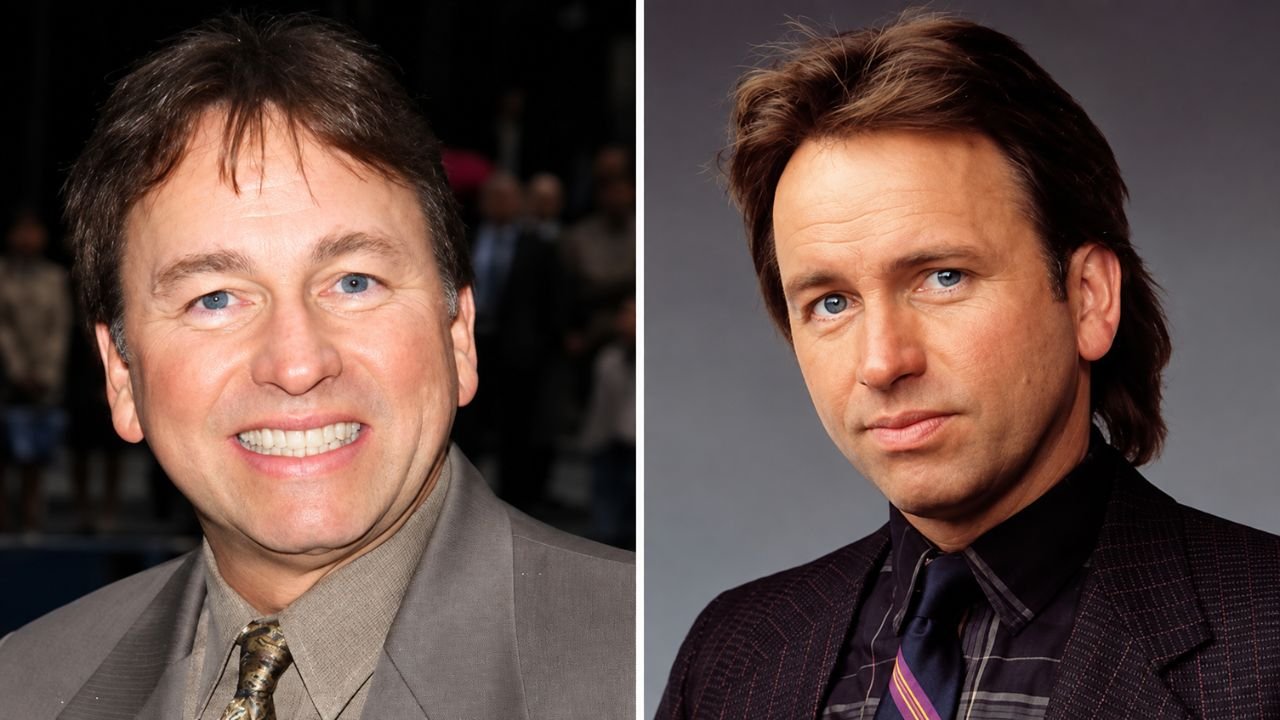
John Ritter was an American actor and comedian whose career stretched across television, film, theater, and voice acting. He became a household name through his role as Jack Tripper on Three’s Company, but his career continued to grow long after the sitcom made him famous. He also earned praise for dramatic performances, appeared in successful movies, voiced Clifford the Big Red Dog, and returned to television with 8 Simple Rules. His sudden death in 2003 at the age of 54 brought his career to an early end, but his work continues to be remembered by audiences who grew up watching him.
Early Life and Family Background
John Ritter was born Jonathan Southworth Ritter on September 17, 1948, in Burbank, California. He grew up in a family closely connected to the entertainment business because his father, Tex Ritter, was a well-known country singer and actor, while his mother, Dorothy Fay, was an actress. His older brother Tom had cerebral palsy, and the experience of growing up with him later influenced Ritter’s involvement with charitable causes connected to cerebral palsy. Although entertainment surrounded him from childhood, Ritter did not immediately decide that acting would be his life’s work.
Ritter attended Hollywood High School before enrolling at the University of Southern California. During his college years, his interests included psychology and other subjects before he eventually focused on theater and acting. He studied under respected acting teacher Nina Foch and later worked with Stella Adler, developing the skills that would become important throughout his career. His education gave him a foundation that helped him move comfortably between comedy, drama, television, movies, and stage performances.
John Ritter’s Early Acting Career
Before becoming one of television’s most recognizable sitcom stars, John Ritter spent years building experience through smaller television appearances. He appeared in programs such as The Waltons, Hawaii Five-O, MAS*H, Kojak, The Bob Newhart Show, and The Mary Tyler Moore Show. He also had a recurring role as Reverend Matthew Fordwick on The Waltons, giving viewers an early opportunity to see his acting abilities. These roles helped him establish himself as a dependable television performer before his biggest breakthrough arrived.
Ritter’s early career showed that he was not simply a comedian waiting for a sitcom opportunity. He worked across different genres and gradually developed a reputation for strong timing and an expressive performance style. His ability to move between serious scenes and physical comedy later became one of the defining characteristics of his career. By the time he reached the late 1970s, he had already accumulated enough television experience to handle the demands of a leading role.
John Ritter and Three’s Company
The role that changed John Ritter’s career was Jack Tripper in Three’s Company. The ABC sitcom premiered in 1977 and centered on Jack, Janet Wood, and Chrissy Snow as roommates living together under circumstances that created constant misunderstandings. Ritter’s performance made Jack one of television’s most memorable sitcom characters. His physical comedy, facial expressions, quick reactions, and carefully timed movements became a major part of the show’s appeal.
Three’s Company ran for seven seasons and gave Ritter a platform that turned him into a major television star. His performance was recognized with major industry awards, including a Primetime Emmy Award and a Golden Globe Award. The character of Jack Tripper also demonstrated Ritter’s ability to make physical comedy look effortless while still giving the character personality and emotional depth. Even decades after the show ended, Jack Tripper remains the role most closely associated with his name.
Why Jack Tripper Became So Popular
Ritter’s success as Jack Tripper came from more than exaggerated physical comedy. He understood how to react to the other actors around him and could communicate a character’s confusion or embarrassment without saying much. His timing allowed simple situations to become elaborate comedic sequences. That combination helped make him one of the most recognizable sitcom performers of his generation.
Some of the qualities that made his performance memorable included:
- Exceptional physical comedy and timing
- Expressive facial reactions
- Strong chemistry with his co-stars
- Ability to move quickly between dialogue and physical humor
- A natural ability to make awkward situations entertaining
- A warm and approachable screen presence
John Ritter Shows and Movies
The career of John Ritter extended far beyond Three’s Company. After establishing himself as a major television performer, he continued working in sitcoms, dramas, television movies, feature films, theater, and voice acting. His later television projects included Three’s a Crowd, Hooperman, Hearts Afire, and 8 Simple Rules for Dating My Teenage Daughter. He also appeared in a wide selection of films that allowed him to explore both comedy and dramatic material.
His film career included projects such as Problem Child, Problem Child 2, Skin Deep, Noises Off, It, and Sling Blade. These movies demonstrated that he could adapt to different types of characters instead of relying entirely on the style that made him famous. His role in Sling Blade was particularly valuable because it allowed audiences to see a more dramatic side of his acting. His filmography therefore provides a broader picture of his abilities than Three’s Company alone.
John Ritter Movies and Memorable Film Roles
John Ritter movies covered a wide range of genres, although comedy remained an important part of his work. He appeared in Problem Child and its sequel, where his comedic performance introduced him to a younger generation of movie audiences. He also appeared in Skin Deep and Noises Off, both of which gave him opportunities to use his strengths as a physical and verbal comedian. His work in horror and drama also showed that he was willing to move outside the sitcom format.
One of the most interesting entries in his film career was Sling Blade, released in 1996. Ritter played Vaughan Cunningham in the acclaimed drama written and directed by Billy Bob Thornton. The film gave him an opportunity to play a grounded dramatic character rather than the exaggerated personalities often associated with his comedy work. His performance helped reinforce the idea that he was a versatile actor capable of handling serious material.
John Ritter as Clifford the Big Red Dog
Another important part of Ritter’s later career came through voice acting. He became the voice of Clifford in the animated television series Clifford the Big Red Dog. The role introduced his voice and personality to children and families who may not have known him primarily from Three’s Company. Ritter brought warmth and humor to Clifford, helping the character become closely associated with his voice during the show’s early years.
His work as Clifford was also recognized by the television industry. The role earned him Daytime Emmy attention and became one of his most recognizable late-career projects. It is an important reminder that Ritter continued developing his career instead of simply repeating the type of role that had made him famous decades earlier.
John Ritter and 8 Simple Rules
In 2002, John Ritter returned to a leading television role as Paul Hennessy in 8 Simple Rules for Dating My Teenage Daughter. The sitcom focused on the challenges faced by a father raising teenage daughters, with Ritter working alongside Katey Sagal and a young Kaley Cuoco. The series allowed him to combine the warmth of a family comedy with the physical humor that had been part of his earlier career. His performance quickly became one of the central reasons viewers connected with the show.
The series became especially significant after Ritter’s death during its second season. Rather than simply replacing his character, the show addressed Paul’s death within the storyline. The remaining cast members continued the series while acknowledging the loss of its central father figure. This made 8 Simple Rules an important final chapter in the television career of John Ritter.
John Ritter’s Theater Career
Television audiences sometimes overlook the fact that Ritter also had a substantial theater background. He appeared in stage productions and continued to work in theater throughout his career. His stage work included productions such as Love Letters, The Glass Menagerie, As You Like It, Butterflies Are Free, and The Dinner Party. Theater gave him a different environment in which to demonstrate his acting skills because performances had to be delivered live without the editing and retakes available in film and television.
His theater experience also helped explain why he was able to handle demanding television performances. Stage acting requires concentration, timing, preparation, and an understanding of character development. Ritter brought those skills into his screen work, allowing him to remain effective even when a scene required a shift from comedy to something more serious. His career was therefore broader than his most famous sitcom role suggests.
John Ritter’s Wife and Marriages
John Ritter’s personal life also attracted public interest throughout his career. He was first married to actress Nancy Morgan, and the couple had children together before their marriage ended. Ritter later married actress Amy Yasbeck, with whom he remained until his death in 2003. Yasbeck had also worked with Ritter professionally, including appearances in projects connected to his acting career.
Amy Yasbeck became an important part of Ritter’s legacy after his death. She helped establish the John Ritter Foundation for Aortic Health, an organization dedicated to education, awareness, and research involving thoracic aortic disease. Her work helped transform a devastating personal loss into an effort to help other families understand a potentially life-threatening medical condition. This part of their story remains an important element of Ritter’s legacy.
John Ritter Children and Family
John Ritter had four children, and two of his sons later became actors themselves. His children include Jason Ritter, Tyler Ritter, Carly Ritter, and Noah Ritter. Jason developed a successful acting career in television and film, while Tyler also followed his father into acting. Their careers have kept the Ritter name connected to the entertainment industry.
The relationship between John Ritter and his children is another reason his biography continues to attract interest. His career was already significant on its own, but the fact that two of his sons entered acting creates a natural connection between generations of performers. Jason and Tyler have spoken publicly about their father and the influence he had on their lives and careers. Their continued work also helps introduce younger audiences to the legacy of John Ritter.
Did John Ritter’s Son Die?
Searches for “john ritter son death” can create confusion because people sometimes mistake information about John Ritter’s death for information about one of his sons. John Ritter’s sons Jason Ritter and Tyler Ritter did not die with their father. Both continued living and pursuing careers after his death, with Jason becoming particularly well known for his work in television and film.
The confusion is understandable because Ritter’s death received extensive media attention and his family became part of the public story surrounding his final years. However, it is important to separate the death of John Ritter from the lives and careers of his children. A clear biography should state the family information accurately rather than repeat a misleading search phrase as a factual claim.
How Did John Ritter Die?
John Ritter died on September 11, 2003, at Providence Saint Joseph Medical Center in Burbank, California. He became seriously ill while rehearsing for 8 Simple Rules and experienced symptoms that included chest discomfort and other signs of a medical emergency. His condition was initially treated as a heart-related problem, but doctors later determined that he had suffered an aortic dissection. Despite emergency treatment, he died at the age of 54.
The timing of his death made the tragedy even more shocking because he was still actively working and had recently returned to television success. He died only six days before his 55th birthday. His death also had a major impact on the cast and crew of 8 Simple Rules, as well as on viewers who had followed his career for decades. The sudden loss of an actor who was still performing at a high level made his final television role particularly memorable.
John Ritter Cause of Death
The john ritter cause of death was an aortic dissection, a serious condition involving a tear in the inner layer of the body’s main artery, the aorta. Blood can enter the wall of the artery through the tear, creating a potentially life-threatening situation. Ritter’s case received significant attention because the condition was not initially recognized correctly. His family later became involved in efforts to raise awareness about aortic disease.
The circumstances surrounding his death eventually led to a wrongful-death lawsuit involving the medical care he received. The case attracted public attention because of questions about whether his condition could have been recognized earlier. Doctors involved in the case were ultimately cleared of negligence by a jury, while other parties reached settlements with the family. The medical details should be discussed carefully because Ritter’s death was a genuine tragedy rather than simply a celebrity news story.
The John Ritter Foundation and His Legacy
Following Ritter’s death, Amy Yasbeck helped establish the John Ritter Foundation for Aortic Health. The foundation focuses on education, research, and awareness related to thoracic aortic aneurysms and dissections. Its work has helped keep Ritter’s name connected to efforts aimed at preventing similar tragedies. The foundation has also become an important part of how his family continues his legacy.
Ritter’s legacy extends well beyond his death. Fans continue to watch Three’s Company, his movies remain available to new audiences, and his work as Clifford introduced him to a generation of children. His performances in projects such as Sling Blade and 8 Simple Rules also demonstrate the range he developed during his career. Rather than being remembered only as Jack Tripper, he is increasingly recognized as an actor who worked successfully across several forms of entertainment.
John Ritter’s Awards and Achievements
Ritter received major recognition during his career, particularly for his television performances. His work on Three’s Company earned him both an Emmy Award and a Golden Globe Award. He also received additional nominations for his television work, showing that his success was not limited to a single award-winning season. His performances continued to attract industry attention even as he moved into different types of projects.
His achievements can be summarized through several important milestones:
- Primetime Emmy Award winner
- Golden Globe Award winner
- Multiple Emmy nominations
- Golden Globe nominations
- Recognized for his work on Three’s Company
- Emmy recognition for Clifford the Big Red Dog
- Hollywood Walk of Fame star
- Successful careers in television, film, theater, and voice acting
Why John Ritter Is Still Remembered
The lasting popularity of John Ritter comes from the unusual combination of comedy, warmth, and versatility he brought to his performances. Jack Tripper made him famous, but his later work proved that he could take on very different roles without losing the qualities audiences liked about him. His performances in films, dramatic television, stage productions, and animated programs created a career that reached several generations.
His influence is also visible through his children, especially Jason Ritter and Tyler Ritter, who followed him into the acting profession. His foundation work created another lasting connection between his name and public awareness of aortic disease. For longtime fans, his sudden death remains one of the saddest moments in television history. For younger audiences, his work continues to be discovered through streaming, television reruns, films, and the careers of his children.
Frequently Asked Questions About John Ritter
Who was John Ritter?
John Ritter was an American actor and comedian best known for playing Jack Tripper on Three’s Company. He also appeared in numerous films and television shows, performed on stage, and voiced Clifford the Big Red Dog. His career included both comedy and dramatic roles. He died in 2003 at the age of 54.
What was John Ritter’s most famous role?
John Ritter’s most famous role was Jack Tripper on Three’s Company. The character made him a major television star and earned him both an Emmy Award and a Golden Globe Award. His physical comedy and timing became closely associated with the character. Jack Tripper remains the role most commonly connected with his name.
How did John Ritter die?
John Ritter died on September 11, 2003, from an aortic dissection. He became ill while working on 8 Simple Rules and was taken to a hospital in Burbank. His condition was initially treated as a heart attack before doctors identified the aortic dissection. He died at age 54.
Who was John Ritter’s wife?
John Ritter’s second wife was actress Amy Yasbeck. The couple married in 1999 and remained together until Ritter’s death in 2003. Yasbeck later helped establish the John Ritter Foundation for Aortic Health. She has remained closely connected to efforts honoring Ritter’s memory and raising awareness of aortic disease.
How many children did John Ritter have?
John Ritter had four children: Jason Ritter, Tyler Ritter, Carly Ritter, and Noah Ritter. Jason and Tyler both became actors, continuing the family’s connection to the entertainment industry. His children have spoken about their father and his influence on their lives. Their careers have also helped keep the Ritter family name familiar to new audiences.
Conclusion
John Ritter built a career that was much larger than the role that first made him famous. From his early television appearances and unforgettable performance as Jack Tripper to his movies, theater work, voice acting, and final starring role in 8 Simple Rules, he continually showed that he was capable of more than one type of performance. His work earned major awards and introduced him to audiences across several generations. Although his death in 2003 ended his career far earlier than expected, his performances remain part of American television and film history.
The story of John Ritter also extends beyond entertainment. His family, especially Amy Yasbeck, turned the circumstances surrounding his death into an effort to raise awareness about aortic disease, while his children Jason and Tyler continued the family’s connection to acting. That combination of professional achievement, family influence, and charitable work gives his legacy a depth that goes beyond his most famous sitcom character. For audiences discovering his work today, John Ritter remains a memorable performer whose career ended too soon but whose impact has endured.