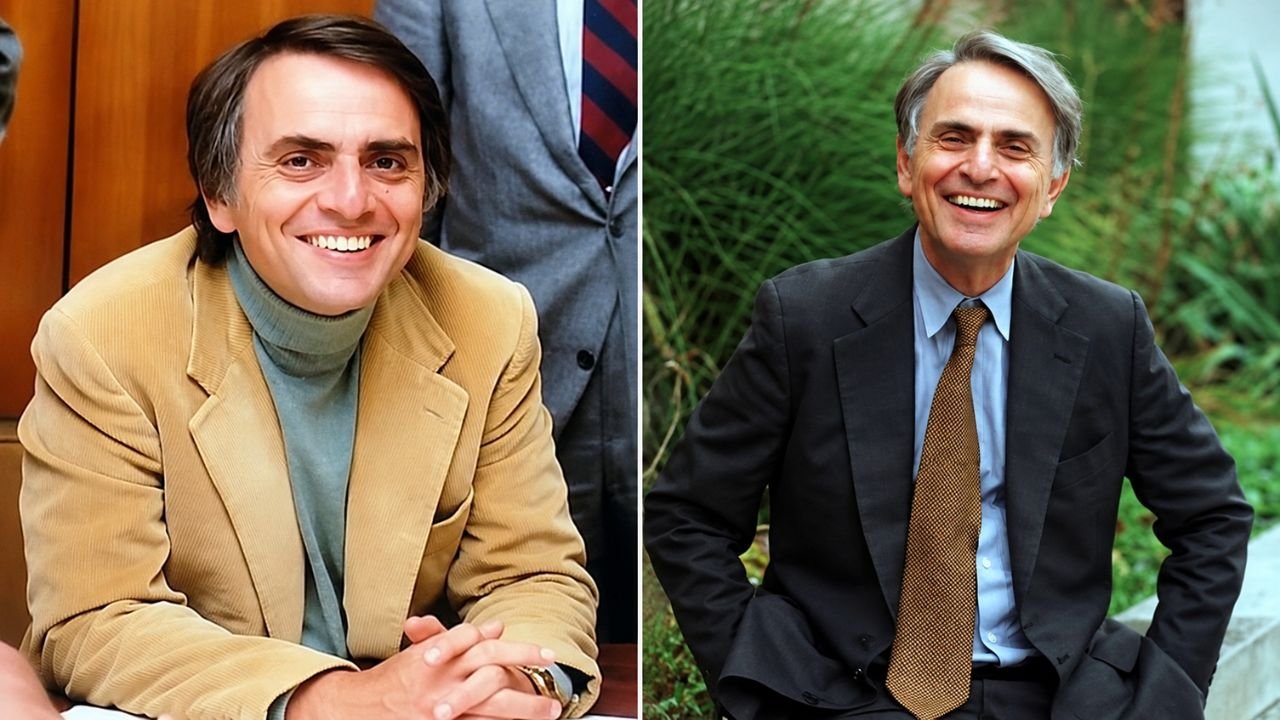
Carl Sagan was one of the most influential scientists and science communicators of the 20th century. He combined serious scientific research with an unusual ability to explain complex ideas in a way that ordinary people could understand. His work covered planetary science, astronomy, extraterrestrial life, space exploration and scientific skepticism, while his books and television programs introduced millions of people to the universe. From his early fascination with stars to his work with NASA and The Planetary Society, his career connected scientific discovery with public curiosity. Even decades after his death, Carl Sagan remains closely associated with Cosmos, the Pale Blue Dot, the Voyager Golden Record and the search for life beyond Earth.
Carl Sagan’s Early Life and Family Background
Carl Edward Sagan was born on November 9, 1934, in Brooklyn, New York City. His father, Samuel Sagan, was a garment worker who had emigrated from Ukraine, while his mother, Rachel Molly Gruber, was a homemaker from New York. Sagan grew up in a modest family environment, but his parents encouraged his curiosity about the world around him. His early experiences with books, science fiction and astronomy gradually turned an ordinary childhood interest into a lifelong passion. These influences played an important role in shaping the scientist and educator he would eventually become.
Sagan developed an interest in astronomy when he was very young. He became fascinated by the stars and eventually understood that they were distant suns rather than small lights in the night sky. His visit to the 1939 New York World’s Fair also had a strong effect on his imagination because the event presented ideas about technology and the future. Science-fiction stories further encouraged him to think about other worlds and the possibility of life beyond Earth. These early interests later became central themes in his scientific research and public work.
Carl Sagan’s Education and University Years
Sagan attended Rahway High School in New Jersey after his family moved from Brooklyn. He was academically successful and developed a particularly strong interest in chemistry and astronomy. He even created a laboratory at home and became president of his school’s chemistry club. While still a teenager, he began thinking seriously about whether astronomy could become a professional career rather than simply a personal hobby.
At only 16, Sagan entered the University of Chicago, where he received a broad education in physics and related scientific subjects. His university years exposed him to influential scientists and important ideas about the physical universe and the origin of life. He earned undergraduate degrees before continuing his studies in physics, astronomy and astrophysics. He eventually completed his doctorate in astronomy and astrophysics, giving him the academic foundation for his later research.
Carl Sagan’s Scientific Career
Carl Sagan became known for research involving planetary atmospheres, planetary surfaces and the possibility of life beyond Earth. His scientific work helped change how researchers understood several worlds in our solar system. Rather than viewing planets simply as distant objects in the night sky, he examined their atmospheres, temperatures, chemistry and potential environments for life. His research demonstrated that planetary science could reveal important information about both other worlds and Earth itself.
One of his important areas of research involved Venus. Sagan helped explain why Venus has such an extremely high surface temperature by studying its thick atmosphere and powerful greenhouse effect. He also contributed to scientific understanding of Mars, including its seasonal changes and the role of dust in its atmosphere. His research extended to Titan, Saturn’s largest moon, where he investigated its complex atmospheric conditions and reddish haze.
Carl Sagan and NASA Space Exploration
Sagan became involved with NASA during the early years of the American space program. He served as a scientific adviser and consultant and contributed to discussions surrounding several important planetary missions. He also briefed astronauts before some of the Apollo missions, giving him a connection to the human exploration of the Moon as well as robotic exploration of distant worlds. His scientific expertise made him an important figure in the development of planetary exploration.
His work was connected with several major missions and projects, including:
- Mariner missions to Venus and Mars
- Viking missions to Mars
- Voyager missions to the outer solar system
- Galileo mission to Jupiter
- Research involving planetary atmospheres
- Scientific investigations into the possibility of extraterrestrial life
Sagan’s involvement with planetary exploration helped bring scientific questions about Mars, Venus, Jupiter and the outer solar system to a much wider audience. He understood that space missions were not only engineering achievements but also opportunities to answer fundamental questions about the origins and nature of life. This combination of scientific research and public communication became one of the defining features of his career.
Carl Sagan and the Search for Extraterrestrial Life
The possibility of life beyond Earth remained one of Carl Sagan’s most persistent interests. He believed that the question deserved serious scientific investigation rather than being left entirely to science fiction or speculation. His research in planetary science naturally connected with questions about whether other worlds could possess conditions suitable for life. He also supported scientific efforts to search for intelligent life elsewhere in the universe.
Sagan was involved with efforts related to the search for extraterrestrial intelligence and helped communicate the scientific reasoning behind such research. He also played an important role in projects designed to send information about humanity into space. These projects reflected his belief that humanity should remain curious about its place in the universe while approaching extraordinary claims with evidence and careful reasoning.
The Voyager Golden Record and Pioneer Messages
One of the most memorable parts of Sagan’s career was his involvement in messages designed to communicate with potential extraterrestrial civilizations. He played a leading role in the development of the Voyager Golden Record, which traveled aboard the Voyager spacecraft. The record contained sounds, music, images and information intended to provide a small representation of life and culture on Earth. It became one of the most famous examples of humanity attempting to introduce itself to the wider universe.
Sagan was also involved with the Pioneer plaques, which carried visual information about humanity aboard the Pioneer spacecraft. These projects reflected his interest in both science and communication across enormous distances. They were not expected to produce an immediate response, but instead represented a symbolic message about humanity’s existence. His involvement demonstrated how his scientific career often extended beyond conventional research into larger questions about civilization and the future.
Carl Sagan and Cosmos
The television series Cosmos: A Personal Voyage made Carl Sagan famous around the world. The original series premiered in 1980 and presented astronomy, biology, history and scientific ideas through engaging storytelling. Sagan served as host, writer and narrator, bringing scientific subjects to viewers who might never have studied them formally. The program eventually reached hundreds of millions of people across numerous countries.
Cosmos was successful because Sagan did not treat science as a collection of difficult facts. He connected scientific discoveries with human history, imagination and everyday questions about existence. The series also encouraged viewers to think about the enormous scale of the universe and humanity’s position within it. Its success established Sagan as one of the most recognizable science communicators of his generation.
Carl Sagan as an Author and Science Communicator
Sagan wrote extensively throughout his career and reached readers through both scientific and popular works. His books covered astronomy, planetary science, extraterrestrial life, skepticism and humanity’s future in space. Some of his best-known works include Cosmos, The Dragons of Eden, Contact, Pale Blue Dot and The Demon-Haunted World. His writing helped bring scientific subjects to audiences far beyond universities and research institutions.
His novel Contact demonstrated another side of his interests by combining scientific ideas with fiction. The story explored communication with extraterrestrial intelligence and later became a major motion picture. His nonfiction books, meanwhile, often examined how humans understand the universe and how scientific reasoning can help distinguish evidence from unsupported claims. This combination of science, storytelling and critical thinking became an important part of his public identity.
Carl Sagan and the Pale Blue Dot
The Pale Blue Dot became one of the most recognizable images associated with Sagan. He encouraged NASA to have Voyager 1 photograph Earth from an enormous distance, allowing our planet to appear as a tiny point of light in the vastness of space. The resulting photograph became a powerful reminder of how small Earth is compared with the universe around it. Sagan later developed the idea further in his book Pale Blue Dot: A Vision of the Human Future in Space.
The image became important not simply because of its technical achievement but because of what it represented. Earth contains every known human civilization, historical event and living species, yet from billions of miles away it appears almost insignificant. Sagan used this perspective to encourage humility and responsibility toward our planet. The Pale Blue Dot therefore became both a scientific image and a lasting part of his philosophical legacy.
Carl Sagan and The Planetary Society
In 1980, Carl Sagan helped establish The Planetary Society with Bruce Murray and Louis Friedman. The organization was created to promote planetary exploration, space science and the search for life beyond Earth. Sagan became its first president and remained closely associated with its mission throughout his life. The organization later became an important part of the global public movement supporting planetary exploration.
The Planetary Society also creates an important connection between Carl Sagan and Bill Nye. Nye studied at Cornell University and took a class taught by Sagan, while Nye later became a prominent leader of The Planetary Society. This makes their relationship more significant than simply being two famous science communicators from different generations. Sagan helped establish an organization that later became an important part of Nye’s professional life and continued work in space advocacy.
Carl Sagan and Scientific Skepticism
Sagan was also known for defending scientific skepticism and critical thinking. He argued that interesting or extraordinary claims should be examined carefully rather than accepted simply because they are exciting or popular. His interest in skepticism became particularly visible in The Demon-Haunted World, where he discussed science, evidence and the dangers of pseudoscience. He believed that skepticism and curiosity should work together rather than being treated as opposites.
The principle often associated with Sagan is that extraordinary claims require extraordinary evidence. Although the underlying idea existed before him, Sagan became one of its most recognizable public advocates. His approach encouraged people to remain open to possibilities while still demanding reliable evidence. This balance between curiosity and skepticism remains one of the most useful parts of his intellectual legacy.
Carl Sagan’s Awards and Achievements
Sagan received major recognition for both his scientific work and his efforts to explain science to the public. His achievements included NASA honors, professional scientific awards and the Pulitzer Prize for General Nonfiction for The Dragons of Eden. He also received numerous honorary degrees from universities. His recognition reflected the unusual range of his career, which combined academic research, planetary exploration, writing and television.
Some of his notable achievements include:
- Pulitzer Prize for General Nonfiction
- NASA Medal for Exceptional Scientific Achievement
- NASA Distinguished Public Service Medal
- NASA Apollo Achievement Award
- Masursky Award
- Public Welfare Medal
- Oersted Medal
- Numerous honorary degrees
- Leadership in The Planetary Society
- Major contributions to planetary science and science communication
An asteroid was also named 2709 Sagan in recognition of his contribution to science. His name has continued to appear in scientific, educational and space-related projects long after his death.
Carl Sagan’s Wife and Family
Carl Sagan was married three times during his life. His marriages were to Lynn Margulis, Linda Salzman and Ann Druyan, with his marriage to Druyan beginning in 1981 and continuing until his death. He had five children from his relationships and family life remained separate from much of his public scientific career. Ann Druyan was also an important creative collaborator who worked with Sagan on several projects.
Druyan was closely involved with the development of Cosmos and other aspects of Sagan’s public work. Their professional and personal partnership became an important part of his later career. After his death, Druyan continued contributing to projects connected with science communication and the Cosmos legacy. Their collaboration helped ensure that many of Sagan’s ideas continued reaching new audiences.
Carl Sagan’s Final Years and Death
During the final years of his life, Sagan continued working despite serious health problems. He suffered from myelodysplasia, a disease affecting the bone marrow, and underwent extensive medical treatment. His health eventually deteriorated, and complications led to pneumonia. Carl Sagan died on December 20, 1996, at the age of 62.
His death came while he was still an active figure in science and public education. He had spent decades encouraging people to explore the universe through evidence, curiosity and scientific reasoning. The work he left behind included research papers, books, television programs and organizations that continued after his death. His passing therefore marked the end of his personal career but not the end of his influence.
Lesser-Known Facts About Carl Sagan
There are several details about Sagan that can make a biography more interesting for readers who already know about Cosmos.
- He entered the University of Chicago at only 16.
- He became interested in astronomy during childhood.
- He worked with NASA on several planetary exploration projects.
- He helped develop the Voyager Golden Record.
- He was involved with the Pioneer plaques.
- He was a founder and first president of The Planetary Society.
- He served as editor of the planetary science journal Icarus.
- He briefly worked as a consultant on 2001: A Space Odyssey.
- He won the Pulitzer Prize for The Dragons of Eden.
- Asteroid 2709 Sagan was named in his honor.
- His work influenced later generations of science communicators, including Bill Nye.
Carl Sagan’s Lasting Legacy
Carl Sagan left an influence that reaches far beyond his original academic field. He helped make planetary science understandable to people who had never studied astronomy, while his research contributed to scientific understanding of planets and their environments. Through Cosmos, his books and his work with NASA, he encouraged generations of people to look at science as a way of understanding the world rather than simply a school subject. His support for planetary exploration also helped build public interest in missions beyond Earth.
His legacy can be seen across several areas:
- Astronomy and planetary science
- Space exploration
- Science education
- Scientific skepticism
- Popular science writing
- Search for extraterrestrial life
- Television and documentary production
- Public support for space exploration
- The Planetary Society
- Inspiration for later science communicators
The continued interest in Carl Sagan shows that his message did not depend on the technology or television programs of his era. His central ideas about curiosity, evidence, exploration and humanity’s place in the universe remain relevant. His work encouraged people to ask difficult questions while remaining willing to change their understanding when evidence demanded it. That combination of curiosity and intellectual discipline is perhaps the strongest part of his lasting reputation.
Frequently Asked Questions About Carl Sagan
Who was Carl Sagan?
Carl Sagan was an American astronomer, planetary scientist, author and science communicator. He conducted research on planets and planetary atmospheres and worked with NASA on several space missions. He became internationally famous as the host of Cosmos: A Personal Voyage. He also helped establish The Planetary Society and promoted scientific research into the possibility of life beyond Earth.
What was Carl Sagan famous for?
Carl Sagan was best known for Cosmos, his work in planetary science, his involvement with NASA and his efforts to communicate science to the public. He also became closely associated with the Pale Blue Dot, the Voyager Golden Record and The Planetary Society. His books helped make astronomy and scientific skepticism accessible to general readers. His ability to combine research with public education made him one of the most recognizable scientists of his era.
What did Carl Sagan discover?
Sagan contributed to scientific understanding of planetary atmospheres and environments rather than making one single discovery that defines his career. His research helped explain Venus’s extreme temperature through its greenhouse effect and contributed to understanding seasonal changes on Mars. He also studied Titan’s atmosphere and investigated questions surrounding planetary conditions and extraterrestrial life. His broader scientific contributions supported the development of modern planetary science.
How old was Carl Sagan when he died?
Carl Sagan was 62 years old when he died on December 20, 1996. He had been born on November 9, 1934, in Brooklyn, New York City. At the time of his death, he was still associated with Cornell University and remained active in scientific and educational work. His career had already influenced both professional scientists and millions of members of the public.
What was Carl Sagan’s connection to Bill Nye?
Bill Nye studied at Cornell University and took a class taught by Carl Sagan. Sagan’s approach to communicating scientific ideas influenced Nye, who later became a major science educator and television personality. Nye also became closely involved with The Planetary Society, the organization Sagan co-founded in 1980. Their connection therefore links Sagan’s scientific and educational legacy with a later generation of science communicators.
Conclusion
Carl Sagan built a career that connected scientific research with public curiosity in a way few scientists have matched. His work on Venus, Mars, Titan and other planetary subjects contributed to our understanding of the solar system, while his involvement with NASA placed him close to some of the most important space missions of the 20th century. Through Cosmos, his books, the Voyager Golden Record and The Planetary Society, he also showed millions of people why exploring the universe matters. His connection with Bill Nye further demonstrates how his influence continued through later generations of science communicators. Carl Sagan died in 1996, but his ideas about evidence, exploration, critical thinking and humanity’s place in the cosmos continue to shape how people think about science and space.