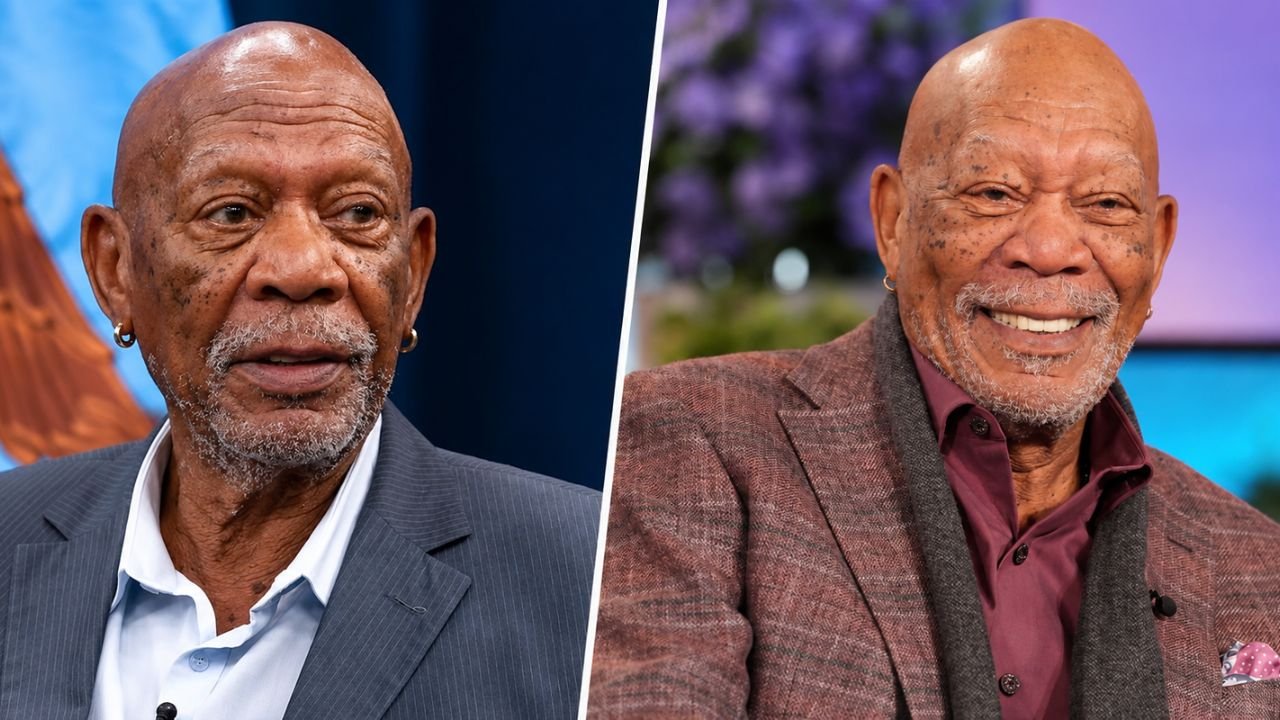
Morgan Freeman is one of the most recognizable actors of his generation, but his path to Hollywood success was far from immediate. Born in Memphis, Tennessee, in 1937, he spent decades working in theater and television before becoming a major film star. His career has included acclaimed dramas, major blockbusters, documentaries, stage productions, directing and producing. From The Shawshank Redemption and Million Dollar Baby to The Dark Knight and Invictus, Morgan Freeman has built a body of work that has remained relevant across generations.
Morgan Freeman’s Early Life and Childhood
Morgan Freeman was born on June 1, 1937, in Memphis, Tennessee, to Morgan Porterfield Freeman and Mayme Edna Revere. His father worked as a barber while his mother was a teacher, and Freeman spent parts of his childhood in Mississippi as well as Tennessee. He grew up during a period when opportunities for Black performers were limited, yet he developed an early fascination with movies, storytelling and performance. Those interests eventually became the foundation for a career that would last for more than six decades.
Freeman’s first meaningful encounter with acting happened when he was about 12 years old. After getting into trouble at school, he was required to participate in a drama competition as a punishment, but the experience produced an unexpected result. He discovered that he had a natural ability for performance and went on to win the competition. That early success gave him an indication that acting could be something more than a childhood pastime.
His childhood interests were not limited to acting. Freeman was fascinated by westerns, war films and aviation, and he sometimes imagined himself as a pilot while growing up. His interest in flying later influenced an important decision after high school. Instead of immediately pursuing an acting education, he chose a path that took him into the United States Air Force.
Morgan Freeman’s Military Service
After graduating from Broad Street High School in Mississippi in 1955, Freeman joined the United States Air Force. He had hoped that military service might eventually lead him toward becoming a fighter pilot, partly because of his childhood fascination with aircraft. His actual duties were more technical, and he trained to work with radar and aircraft-related equipment. Freeman served in the Air Force until 1959 before deciding that military life was not the career he wanted to continue.
His years in the Air Force became an unusual chapter in his biography because they placed him on a completely different path from the entertainment industry. At a time when many young performers were trying to break into theater or television, Freeman was working in military aviation. The experience gave him discipline and independence while also helping him understand what he wanted from his future. Once he left the service, he began focusing more seriously on acting.
Freeman’s decision to leave the Air Force did not immediately lead to fame. He moved between cities, took ordinary jobs and continued looking for opportunities in entertainment. His early years were marked by auditions, theater work and small roles rather than instant Hollywood success. That long period of preparation would later become one of the defining features of his career.
Morgan Freeman’s Theater Career
Before becoming famous for Morgan Freeman movies, Freeman spent years building his reputation on the stage. Theater gave him an opportunity to develop the controlled delivery, timing and character work that later became central to his film performances. He appeared in productions such as Hello, Dolly!, Purlie, The Mighty Gents and Coriolanus. His stage career eventually brought him several important honors, including Obie Awards and recognition from the theater community.
One of the most important stage roles of his early career was Hoke Colburn in Driving Miss Daisy. Freeman first played the character in the original stage production before reprising the role for the acclaimed 1989 film adaptation. His familiarity with Hoke allowed him to bring a deep understanding of the character to the screen. The performance became a major turning point and demonstrated how his theater background could translate into powerful film acting.
His stage experience also helped distinguish him from performers who entered the industry primarily through television. Freeman learned to rely on voice, physical presence and subtle changes in expression rather than exaggerated performances. Those skills later became particularly valuable when he played quiet, thoughtful characters in dramatic films. His theater years were therefore not simply an early chapter in his career; they shaped the acting style audiences would eventually associate with him.
Morgan Freeman and The Electric Company
Television gave Freeman his first opportunity to become widely recognizable to American audiences. During the 1970s, he joined The Electric Company, an educational children’s program designed to help young viewers develop reading skills. He became particularly well known for playing Easy Reader, while also appearing as characters including Mel Mounds and Count Dracula. The program introduced his face and voice to a much larger audience before he became a major movie star.
The Electric Company is an important part of Morgan Freeman’s career because it demonstrates how long he had been working before his breakthrough in Hollywood. Many viewers who later knew him from serious dramas first encountered him through an educational television program. His work on the show also demonstrated his ability to perform for different audiences without losing his individual style. The experience gave him television exposure while he continued developing his theater career.
By the time Freeman moved into more substantial film roles, he had already accumulated years of professional experience. He understood how to work in front of cameras, how to control his voice and how to communicate a character without relying on excessive movement. These skills became increasingly visible as he moved toward more mature roles.
Morgan Freeman’s Breakthrough With Street Smart
The major breakthrough came in 1987 with Street Smart. Freeman played Fast Black, a dangerous hustler whose presence gave the film much of its tension. The performance earned him an Academy Award nomination for Best Supporting Actor. After years of theater, television and smaller film roles, the nomination finally placed him in the center of Hollywood’s serious acting conversation.
Street Smart changed the way the industry viewed Freeman. He was no longer simply a veteran stage performer or television actor; he had demonstrated that he could dominate a feature film with a complex and memorable character. The role also showed that Freeman could play characters very different from the calm and reassuring figures he would become known for later. His performance created momentum that helped lead to larger opportunities.
The breakthrough arrived relatively late compared with many actors who become famous in their twenties or early thirties. Freeman’s experience became an advantage rather than a limitation because he entered major Hollywood productions with decades of performance knowledge behind him. His later success would repeatedly demonstrate the value of that experience.
Morgan Freeman Movies and His Rise in Hollywood
The late 1980s and 1990s transformed Freeman into one of Hollywood’s most respected actors. He appeared in Glory, Driving Miss Daisy, Unforgiven and The Shawshank Redemption, among other major productions. These films allowed him to work with respected directors and established actors while demonstrating his ability to move between historical drama, character-driven stories and crime films. His performances were rarely built around loud displays of emotion; instead, he often relied on restraint and careful delivery.
Driving Miss Daisy became particularly significant because Freeman already understood Hoke Colburn from his stage performance. The movie earned several major awards and nominations, while Freeman received an Academy Award nomination for Best Actor. His portrayal of Hoke combined humor, patience and quiet dignity, helping establish the kind of thoughtful character that would become a recurring part of his career. The role also showed that a performer could become a major Hollywood presence without fitting the conventional image of a young leading man.
His work in Unforgiven added another dimension to his film career. Directed by Clint Eastwood, the western gave Freeman the opportunity to play Ned Logan, a character caught in a violent and morally complicated world. The film won the Academy Award for Best Picture and became one of the most respected westerns of its era. Freeman’s performance further demonstrated his ability to provide emotional weight without dominating every scene.
Morgan Freeman in The Shawshank Redemption
The Shawshank Redemption remains one of the most important films in Morgan Freeman’s career. Released in 1994, the movie was based on Stephen King’s novella Rita Hayworth and Shawshank Redemption. Freeman played Ellis “Red” Redding, a prisoner who becomes a close friend of Andy Dufresne, played by Tim Robbins. His performance earned another Academy Award nomination and eventually became one of the roles most closely associated with his name.
Red is also significant because Freeman’s voice becomes part of the storytelling. His narration gives the audience access to the character’s thoughts while creating a reflective tone throughout the film. The performance depends heavily on patience and observation rather than dramatic outbursts. That approach became one of the reasons the character remained memorable long after the film’s original theatrical release.
The Shawshank Redemption also helped establish Freeman as an actor whose presence could anchor a story even when another character was technically the central figure. His Red is observant, experienced and emotionally guarded, but his friendship with Andy gradually reveals a more hopeful side. The role became a defining example of Freeman’s ability to communicate complicated emotions through small details.
Morgan Freeman’s Oscar Win
Freeman received several Academy Award nominations before finally winning the Oscar. His earlier nominations came for Street Smart, Driving Miss Daisy and The Shawshank Redemption. His first Oscar victory arrived for Million Dollar Baby, where he played Eddie “Scrap-Iron” Dupris. The film was directed by Clint Eastwood and starred Eastwood and Hilary Swank.
Freeman’s performance in Million Dollar Baby was quieter than many traditional award-winning roles. Eddie is an older former boxer who works around a boxing gym and develops a close relationship with the central characters. Freeman gives the character warmth, humor and sadness without turning him into a simple narrator of the story. His performance earned him the Academy Award for Best Supporting Actor at the 2005 ceremony.
His Oscar win represented the culmination of a long progression rather than a sudden breakthrough. Freeman had already spent decades working in theater, television and film before receiving the industry’s most famous acting prize. The award recognized not just one performance but the level of respect he had developed across his career.
Morgan Freeman in The Dark Knight Trilogy
Another major chapter in Morgan Freeman movies came when he joined Christopher Nolan’s Batman films. He played Lucius Fox, a highly intelligent executive who works closely with Bruce Wayne. Freeman appeared in Batman Begins, The Dark Knight and The Dark Knight Rises. The role introduced him to a younger generation of moviegoers while allowing him to remain part of one of the most successful superhero film series of its era.
Lucius Fox is different from many of Freeman’s dramatic characters because the role combines intelligence, humor and technical knowledge. He serves as an important connection between Bruce Wayne’s public business life and Batman’s secret operations. Freeman’s relaxed performance helped balance the darker tone of the trilogy. His chemistry with Christian Bale also became one of the memorable supporting relationships in the films.
The Batman films demonstrated the breadth of Freeman’s career. He could move from intimate character dramas such as Million Dollar Baby to enormous international blockbusters without losing the qualities that made his performances distinctive. His presence gave the films an experienced dramatic actor who could make a supporting character feel important.
Morgan Freeman as Nelson Mandela in Invictus
In 2009, Freeman portrayed Nelson Mandela in Invictus. The film focused on Mandela’s efforts to use rugby as a way of encouraging unity in post-apartheid South Africa. Matt Damon played rugby captain Francois Pienaar, while Freeman portrayed Mandela with a calm and measured performance. The role earned Freeman another Academy Award nomination for Best Actor.
Playing a real historical figure presented a different challenge from playing fictional characters. Freeman had to capture Mandela’s speech patterns, physical mannerisms and public presence while avoiding a simple imitation. His performance emphasized Mandela’s patience and political intelligence rather than turning the character into a conventional heroic figure. The film became another important example of Freeman taking on a role connected to major historical events.
Invictus also reflected Freeman’s work behind the scenes because his production company was involved with the film. His career therefore extended beyond acting, with producing becoming another important part of his professional life.
Morgan Freeman as a Narrator
Morgan Freeman’s voice has become one of his most recognizable professional characteristics. He has narrated documentaries, television programs and other productions, bringing a measured and authoritative style to factual storytelling. His narration credits include March of the Penguins, Through the Wormhole, The Story of God with Morgan Freeman and several other documentary projects. His voice became so closely associated with narration that it developed into a separate part of his public identity.
March of the Penguins was especially notable because the documentary became an international success. Freeman’s narration helped guide audiences through the harsh environment and difficult journey of emperor penguins. He later continued working on documentary projects covering subjects such as science, religion, history and the natural world.
His narration career demonstrates that an actor does not need to appear on screen to make a production memorable. Freeman can create atmosphere simply through rhythm, pauses and tone. That ability has made his voice useful in projects that require both authority and emotional restraint.
Morgan Freeman as a Director and Producer
Freeman has also worked behind the camera. His directorial debut came with Bopha! in 1993, a film dealing with apartheid-era South Africa. Directing gave him an opportunity to explore social and political themes from a different position within the filmmaking process. Although acting remained his primary profession, the experience established that he was interested in more than performing in front of the camera.
In 1996, Freeman and producer Lori McCreary founded Revelations Entertainment. The company became involved in film and television projects that explored historical, political and social subjects. Its work included productions connected to Freeman’s interests in storytelling and factual subjects. The company later became involved with projects such as Madam Secretary.
His producing work is important when considering the full scope of his career. Freeman has not simply accepted acting roles throughout his professional life. He has also helped develop projects, shape productions and support stories that might not have been possible through acting alone.
Morgan Freeman’s Age and Life Outside Acting
Morgan Freeman was born on June 1, 1937, which makes him 89 years old in 2026. His age is particularly notable because his professional career remains active rather than belonging entirely to the past. He continues to appear in films, participate in documentary projects and work on creative ventures. Few actors maintain such a long professional presence while continuing to take on new projects.
Freeman has also maintained interests outside traditional acting. He has been a licensed private pilot and has a longstanding connection with sailing. His interest in aviation connects back to his childhood fascination with aircraft and his early decision to join the Air Force. Those interests provide a glimpse of the person behind the public image of the actor.
What Happened to Morgan Freeman’s Hand?
A serious car accident in Mississippi in 2008 caused permanent damage to Freeman’s left hand. The injury affected the nerves and circulation in the hand and has resulted in lasting swelling. Freeman has been photographed and interviewed wearing a compression glove, which helps manage the condition. The injury is one of the most frequently searched personal details about his later life.
The accident did not end Freeman’s career. He continued acting after the incident and remained active in film, television and narration. The hand injury is therefore best understood as a difficult personal event that became part of his later life rather than as something that defined his professional identity. His continued work demonstrates how strongly he remained committed to acting and other creative projects.
Morgan Freeman Wife and Family
Morgan Freeman has been married twice. His first marriage was to Jeanette Adair Bradshaw, whom he married in 1967, and the couple later divorced. He subsequently married Myrna Colley-Lee in 1984, and their marriage ended in divorce in 2010.
Freeman has children and grandchildren, although he has generally maintained a level of privacy around his family life. His public career has received far more attention than his private relationships. For that reason, discussions about his wife and family should distinguish between confirmed biographical information and speculation found in celebrity coverage.
His personal life has never been the central reason for his fame. Instead, his professional achievements have remained the defining part of his public identity. That distinction is useful when discussing Morgan Freeman wife-related searches without allowing personal-life details to overwhelm the biography.
Morgan Freeman Net Worth and Sources of His Wealth
Morgan Freeman’s net worth is often estimated at around $250 million by celebrity-focused financial publications. However, this figure should be treated as an estimate rather than an officially verified personal financial statement. His long career in film and television, along with producing, directing and narration work, provides several sources of professional income. His involvement in successful productions across several decades has also contributed to his financial position.
His wealth cannot be attributed to acting salaries alone. Freeman has worked as a producer, director and narrator and has been involved in entertainment ventures outside conventional acting roles. His production company has also given him opportunities to participate in projects from behind the scenes. The length and consistency of his career are important factors when considering why his estimated wealth is so high.
Morgan Freeman’s Major Awards and Honors
Freeman’s career has been recognized by major organizations in film, theater and the arts. His awards and honors reflect the fact that his work extends well beyond popular movies. Some of the most notable recognitions associated with his career include:
- Academy Award for Best Supporting Actor for Million Dollar Baby
- Golden Globe recognition for Driving Miss Daisy
- Multiple Academy Award nominations
- Obie Awards for theater performances
- National Medal of Arts
- Kennedy Center Honors
- AFI Life Achievement Award
- Hollywood Walk of Fame star
- Screen Actors Guild honors
His Hollywood Walk of Fame star was unveiled in 2003 on Hollywood Boulevard. The recognition placed his name among performers whose careers have had a lasting influence on American entertainment. His National Medal of Arts honor also recognized his contributions as an actor, director and narrator.
Morgan Freeman’s Connection to the Blues
Music, particularly blues, has become another important part of Freeman’s life. He co-founded Ground Zero Blues Club in Clarksdale, Mississippi, a city strongly associated with the history of Delta blues. The club was created in part to provide visitors with a place to experience live blues music while connecting with the musical heritage of the Mississippi Delta.
In 2026, Freeman expanded this interest through Morgan Freeman’s Symphonic Blues Experience. The project combines blues performances with orchestral arrangements and features respected musicians alongside a large ensemble. Freeman’s role focuses on production and narration rather than presenting himself as the project’s primary musician. The project shows that his interests continue to develop even after decades in Hollywood.
Morgan Freeman’s Career in 2026
At 89, Freeman continues to work rather than treating retirement as the natural end of his career. His recent activities include acting, narration, production and his involvement with the blues project. He has also continued participating in interviews and discussions about his career. His willingness to keep accepting interesting work has allowed him to remain part of popular culture long after many performers from his generation stepped away from the industry.
His current career is particularly interesting because it doesn’t depend on recreating his past successes. Instead, Freeman continues to explore different forms of storytelling. Film, documentaries, narration, music and producing all remain connected to his professional life. That adaptability has helped him remain relevant to audiences who were not even born when he first started performing professionally.
Why Morgan Freeman Remains an Influential Actor
Morgan Freeman’s influence comes from the unusual length and variety of his career. He spent years working in theater and television before becoming a major movie star, which gave him a foundation that many later performers did not have. His performances often rely on voice, timing, restraint and character development rather than exaggerated emotion. Those qualities have allowed him to work successfully across drama, crime, historical films, action movies and documentaries.
His most memorable roles also share an ability to make supporting characters feel essential to the story. Red in The Shawshank Redemption, Lucius Fox in The Dark Knight trilogy and Eddie Dupris in Million Dollar Baby all contribute more than simple background support. Freeman gives each character a distinct personality and emotional history. That consistency is one reason audiences continue to recognize his performances even when the roles themselves are very different.
Frequently Asked Questions About Morgan Freeman
How old is Morgan Freeman?
Morgan Freeman was born on June 1, 1937, making him 89 years old in 2026. He has continued working in entertainment despite being one of Hollywood’s oldest active stars. His career has now covered more than six decades.
What is Morgan Freeman’s most famous movie?
The Shawshank Redemption is widely regarded as one of Morgan Freeman’s most famous films. His performance as Ellis “Red” Redding became one of the defining roles of his career. Other major films include Million Dollar Baby, Driving Miss Daisy, Se7en, Invictus and The Dark Knight trilogy.
What happened to Morgan Freeman’s hand?
Morgan Freeman injured his left hand in a serious car accident in 2008. The injury caused lasting nerve and circulation problems, including swelling. He has often worn a compression glove to help manage the condition.
Who is Morgan Freeman’s wife?
Morgan Freeman has been married twice. His first marriage was to Jeanette Adair Bradshaw, and his second marriage was to Myrna Colley-Lee. His marriage to Colley-Lee ended in divorce in 2010.
What is Morgan Freeman’s net worth?
Morgan Freeman’s net worth is commonly estimated at around $250 million by celebrity financial publications. The figure is an estimate rather than an officially confirmed amount. His income has come from acting, narration, producing, directing and other entertainment activities throughout his long career.
Conclusion
Morgan Freeman’s career is a story of persistence rather than overnight success. He discovered acting as a child, spent several years in the Air Force, built his skills through theater and television, and only became a major Hollywood star after decades of work. His performances in The Shawshank Redemption, Driving Miss Daisy, Million Dollar Baby, Invictus and The Dark Knight films established him as an actor capable of moving between very different kinds of stories.
His career also extends beyond acting. Freeman has directed films, produced television and movies, narrated documentaries and developed a strong connection with the blues. Even after reaching an age when many performers have retired, he continues looking for new creative opportunities. That combination of longevity, versatility and willingness to keep working explains why Morgan Freeman remains one of the most respected and recognizable figures in American entertainment.