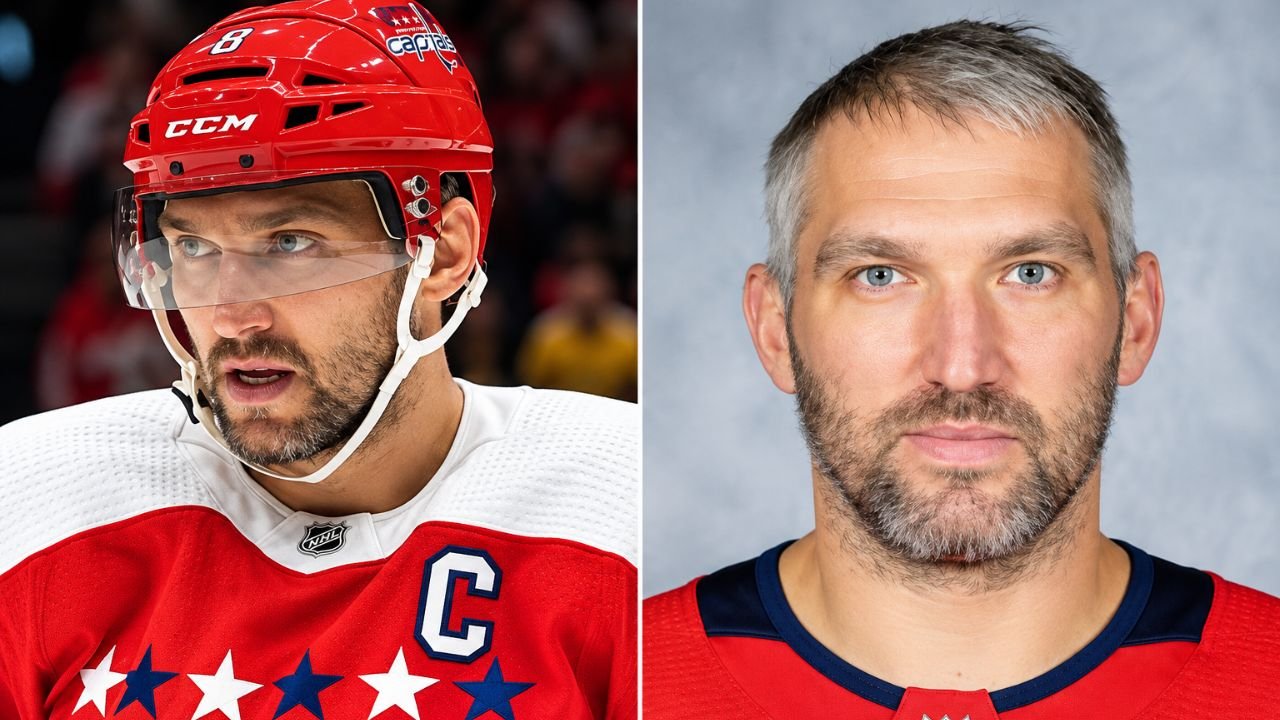
Alex Ovechkin has built one of the most remarkable careers in modern ice hockey, combining extraordinary goal scoring with physical strength, consistency and remarkable longevity. Born in Moscow in 1985, he eventually became the face of the Washington Capitals and one of the most recognizable players in the NHL. His career includes a Stanley Cup championship, numerous individual awards and records that have placed him among the greatest players in hockey history. As of October 2026, Ovechkin is playing his 22nd NHL season, which he has announced will be his final season.
Alex Ovechkin Early Life and Childhood
Alex Ovechkin was born Alexander Mikhaylovich Ovechkin on September 17, 1985, in Moscow, Russia. His family had a strong sporting background, which gave him an environment where professional athletics was already an important part of everyday life. His mother, Tatyana Ovechkina, was an outstanding basketball player who won two Olympic gold medals for the Soviet Union. His father, Mikhail Ovechkin, was a professional football player, so competitive sport was familiar to Alex from an early age.
Ovechkin developed an interest in hockey while growing up in Moscow and quickly showed that he had unusual ability. His childhood was not centered only on natural talent, because he also developed a reputation for determination and a strong desire to improve. His older brother Sergei played an important role in his early life and influenced his interest in hockey. Sergei later died in a car accident when Alex was 10, an event that remained an important personal part of Ovechkin’s story.
His Athletic Family Background
The influence of Ovechkin’s parents is an important part of understanding his development as an athlete. His mother’s experience as an Olympic basketball champion exposed him to elite competition, discipline and the demands of professional sport. His father’s football background also meant that physical competition and athletic training were familiar elements of his upbringing. Ovechkin eventually developed a style of hockey that combined the instincts of a natural scorer with considerable physical strength.
His rise through Russian hockey happened quickly, and by his teenage years he was already attracting attention beyond Moscow. He entered the Dynamo Moscow system and developed into one of the most highly regarded young players in Russia. His performances for Russian junior teams helped establish his reputation internationally before he ever played an NHL game. That early development prepared him for the enormous expectations that followed his selection in the NHL draft.
Alex Ovechkin’s Rise in Russian Hockey
Ovechkin developed through Dynamo Moscow, one of Russia’s historic hockey organizations, and began playing professional hockey while still very young. His performances showed that he could compete against older and more experienced players. He also became involved with Russian national teams at a young age, giving international scouts additional opportunities to evaluate him. By his late teenage years, he was widely regarded as one of the best young hockey prospects in the world.
His international performances strengthened the case for Ovechkin to become a top NHL draft selection. He combined speed, a powerful shot, physical confidence and the ability to create scoring opportunities in different situations. His reputation continued to grow as NHL scouts followed his development in Russia. The Washington Capitals ultimately decided that he was the player they wanted to build their future around.
His International Breakthrough
One of the important stages of Ovechkin’s early career came through international competition. He represented Russia at junior tournaments and demonstrated that his scoring ability could translate against high-level opponents. His performance at the 2002 Under-18 World Championship was particularly notable, as he led the tournament in goals with 14 in eight games. Such performances helped establish him as a prospect capable of becoming a major international and professional star.
His early international experience also exposed him to the pressure that comes with representing Russia. Playing for a national team at a young age requires players to adjust quickly to different teammates, systems and expectations. Ovechkin’s ability to perform in those situations strengthened his reputation before his NHL career began. It also contributed to the belief that he could handle the pressure associated with being a first overall draft selection.
Alex Ovechkin and the 2004 NHL Draft
The Washington Capitals selected Alex Ovechkin with the first overall pick in the 2004 NHL Entry Draft. Being selected first overall placed enormous expectations on him, particularly because Washington was looking for a player capable of becoming the centerpiece of its franchise. Ovechkin eventually justified those expectations in a way few first overall selections ever have. He would spend his entire NHL career with Washington rather than moving between several franchises.
The beginning of his NHL career was delayed by the 2004–05 NHL lockout, but that interruption did not diminish the anticipation surrounding his arrival. When Ovechkin finally made his NHL debut during the 2005–06 season, he immediately showed why Washington had selected him first overall. He scored twice in his debut and finished his rookie campaign with 52 goals and 106 points. His performance earned him the Calder Memorial Trophy as the NHL’s top rookie.
Alex Ovechkin’s NHL Career With Washington
Ovechkin’s relationship with the Washington Capitals became one of the defining stories of his career. Unlike many major stars who change teams during their careers, he remained with the same organization from his NHL debut onward. Over the years, he moved from highly talented young forward to franchise leader and eventually captain. His consistency allowed Washington supporters to watch the same player develop across more than two decades.
His scoring ability became especially dangerous because opponents knew where he wanted to shoot but still struggled to stop him. His trademark one-timer from the left side of the offensive zone became one of the most recognizable scoring plays in hockey. Ovechkin also used his size and strength to battle defenders around the net and create scoring chances from close range. His ability to score in different ways helped him maintain elite production even as he grew older.
The Meaning Behind The Great 8
Ovechkin became widely known as “The Great 8,” a nickname connected to the No. 8 jersey he wore throughout his NHL career. The number became part of his identity in Washington and eventually became almost synonymous with his name. His jersey, goal celebrations and powerful shooting style helped create a recognizable image that extended far beyond hockey. Over time, the nickname became a reference not simply to his number but to his status as one of the sport’s greatest players.
The No. 8 identity also connected Ovechkin’s professional career with his family background. His mother had worn No. 8 during her basketball career, giving the number additional personal meaning. That connection made his choice of jersey number more than a simple branding decision. It became one of the small details that helped define the public image of Ovechkin.
Alex Ovechkin Stats and Career Numbers
Alex Ovechkin’s statistics provide perhaps the clearest explanation of his importance to the NHL. As of October 2026, he has recorded 929 regular-season goals, 759 assists and 1,688 points while continuing his final NHL season. He has also recorded 331 power-play goals and 141 game-winning goals during his NHL career. Because his final season is still underway, these totals can change before his career officially ends.
His career numbers become even more impressive when his goal-scoring consistency is examined over individual seasons. Ovechkin has recorded 20 seasons with at least 30 goals and 14 seasons with at least 40 goals. He has also reached 50 goals nine times, putting him tied for the NHL record in that category. These achievements demonstrate that his success was not based on a short peak but on sustained scoring production across more than two decades.
Some of the most notable Alex Ovechkin stats include:
- 929 regular-season goals
- 759 regular-season assists
- 1,688 regular-season points
- 331 power-play goals
- 141 game-winning goals
- 27 overtime goals
- 476 road goals
- 14 seasons with at least 40 goals
- 20 seasons with at least 30 goals
- 9 seasons with at least 50 goals
These numbers also show why Ovechkin’s career cannot be measured by points alone. His greatest statistical advantage has always been his ability to score goals at an extraordinary rate. Even when his overall production changed with age, his importance as a scoring threat remained obvious. His statistical legacy is therefore closely connected to the goal-scoring records he established.
Alex Ovechkin Goals and the Gretzky Record
The biggest moment of Ovechkin’s career came when he broke Wayne Gretzky’s NHL regular-season goal record. Gretzky had finished his career with 894 regular-season goals, a total that had stood for decades and was widely considered one of the most difficult records in professional sports. Ovechkin eventually reached 894 goals himself on April 4, 2025, against the Chicago Blackhawks. Two days later, he scored his 895th goal against the New York Islanders and officially became the NHL’s all-time regular-season goal scorer.
The circumstances made the achievement even more memorable because Ovechkin broke the record in his 1,487th NHL game. That was exactly the same number of regular-season games Gretzky played during his career. The achievement transformed the “Great 8 versus Great One” discussion from a future possibility into an important part of hockey history. It also established Ovechkin as the player who eventually surpassed one of the most famous records in the sport.
Reaching 900 Goals
Breaking Gretzky’s record did not mark the end of Ovechkin’s pursuit of scoring milestones. He continued playing and eventually became the first player in NHL history to reach 900 regular-season goals. That milestone placed another historic number beside his name and demonstrated that his career was continuing even after he had already achieved the sport’s most famous scoring record. His ability to keep producing at an advanced age has become another major part of his legacy.
Ovechkin’s goal-scoring record includes several categories beyond total goals. He currently leads the NHL in power-play goals, game-winning goals, overtime goals, road goals, game-opening goals, game-tying goals and go-ahead goals. These records show that his influence was not limited to one particular type of scoring situation. He repeatedly found ways to produce goals when Washington needed them.
Alex Ovechkin and the 2018 Stanley Cup
For all of his individual accomplishments, the Stanley Cup remained an important missing achievement for much of Ovechkin’s career. He had already won scoring titles and individual awards, but Washington had not yet captured the championship. That changed during the 2017–18 season when the Capitals reached the Stanley Cup Final and defeated the Vegas Golden Knights.
The championship was the first Stanley Cup in Washington Capitals history. Ovechkin was central to the team’s playoff run and was awarded the Conn Smythe Trophy as the most valuable player of the playoffs. The victory gave him a championship accomplishment that matched his individual statistical success. It also changed the way his career was discussed because he was no longer viewed only as a spectacular individual scorer who had not won the league’s ultimate prize.
Why the 2018 Championship Mattered
The Stanley Cup victory carried special significance because of the years Ovechkin had spent trying to reach that point. Washington had experienced disappointing playoff exits during several earlier seasons, creating questions about whether the team could eventually win a championship. Ovechkin remained committed to the organization throughout those setbacks. When the Capitals finally won, he became one of the most recognizable players associated with the franchise’s greatest achievement.
The championship also strengthened the overall argument surrounding his place among hockey’s elite players. His career was no longer defined only by individual records and scoring titles. He had become a Stanley Cup champion and playoff MVP as well. That combination of individual and team success remains central to discussions about his legacy.
Sidney Crosby and Alex Ovechkin
The story of Sidney Crosby and Alex Ovechkin is one of the defining rivalries of the NHL’s modern era. Crosby entered the league with the Pittsburgh Penguins while Ovechkin became the face of Washington, and both players developed into franchise leaders. Their teams competed in the same division for years, creating repeated regular-season and playoff meetings. Their careers became naturally linked because they entered the NHL during the same period and remained elite for an extraordinary length of time.
The statistical profiles of the two players are also different, which makes comparisons particularly interesting. Ovechkin has established himself as the superior pure goal scorer, while Crosby has traditionally been one of the league’s most productive playmakers and overall point producers. Neither player needs the other to define his career, but their simultaneous success made comparisons almost unavoidable. Their rivalry also developed into mutual respect as both continued playing long after many of their original peers had retired.
As of the 2026–27 season, both players have reached 22 seasons with one franchise. That places them in a very small group of NHL players whose entire careers have been tied to a single organization. Ovechkin’s final season means their meetings now carry additional significance because the long-running rivalry will eventually come to an end. For hockey fans, the connection between Sidney Crosby and Alex Ovechkin has become one of the defining stories of their generation.
Alex Ovechkin Awards and Achievements
Ovechkin’s trophy collection reflects both his individual scoring dominance and his success as a team leader. He has won the Hart Memorial Trophy three times as the NHL’s most valuable player and has also collected three Ted Lindsay Awards. His nine Maurice “Rocket” Richard Trophies demonstrate just how consistently he led the league in goals. He has also won the Art Ross Trophy and Calder Memorial Trophy during his career.
His major achievements include:
- Stanley Cup champion in 2018
- Conn Smythe Trophy winner
- Three-time Hart Trophy winner
- Three-time Ted Lindsay Award winner
- Nine-time Maurice Richard Trophy winner
- Art Ross Trophy winner
- Calder Memorial Trophy winner
- Mark Messier Leadership Award winner
- NHL all-time regular-season goal-scoring leader
- First NHL player to reach 900 regular-season goals
The combination of team success and individual recognition is important when evaluating his career. Ovechkin was not simply a player who accumulated statistics without winning a championship. He eventually led Washington to its first Stanley Cup while also building one of the greatest individual scoring records in professional hockey.
Alex Ovechkin Wife and Family
Alex Ovechkin’s wife is Anastasia Shubskaya, whom he married after their relationship developed in the middle of the 2010s. The couple first met at the 2008 Beijing Olympics and later reconnected several years afterward. Their relationship eventually led to marriage and a family life that Ovechkin has frequently described as an important source of support during his career.
Ovechkin and Shubskaya have two sons, Sergei and Ilya. Their first son was born in 2018, shortly after Ovechkin won the Stanley Cup with Washington, while their second son was born in 2020. Family has become increasingly important to Ovechkin as his career has progressed, particularly as he has approached the final stage of his NHL career.
The connection between hockey and family has also appeared publicly throughout Ovechkin’s career. His children have been part of his life during his years in Washington, and Ovechkin has spoken about enjoying his time with them away from the rink. His decision to make the 2026–27 campaign his final season also comes as he considers the next stage of his life with his family.
Alex Ovechkin Net Worth and Career Earnings
Alex Ovechkin has earned substantial income through NHL contracts, endorsements and other commercial opportunities during his long career. His financial success reflects his status as one of hockey’s most recognizable international stars. However, exact net worth figures reported online should be treated as estimates rather than official financial statements. Salary information and publicly reported earnings can be documented more reliably than a player’s complete personal wealth.
His earning power has also remained significant because his popularity extends beyond the Washington Capitals. Ovechkin has been one of the NHL’s most marketable players for many years, with his distinctive personality and scoring records making him attractive to commercial partners. His longevity has allowed him to maintain a public profile across multiple generations of hockey fans. This commercial impact is another reason his retirement will represent a major change for the NHL.
Alex Ovechkin’s Community Impact
Ovechkin’s influence in Washington has extended beyond statistics and trophies. During his time with the Capitals, hockey participation in the Washington region grew considerably, with his presence helping raise the sport’s profile among younger fans. His Ovi’s 8’s initiative has provided thousands of tickets to children and families who might otherwise have limited opportunities to attend NHL games. His involvement has helped connect his professional career with the wider community.
His community involvement has included support for special hockey programs as well. Ovechkin has supported organizations that provide opportunities for people with disabilities to participate in hockey. These activities show how his influence has developed beyond professional statistics. For a player who spent his entire NHL career in one city, his connection with the local community became an important part of his overall legacy.
Alex Ovechkin’s Final NHL Season
On October 5, 2026, Ovechkin announced that the 2026–27 season would be his final NHL season. The announcement came exactly 21 years after his NHL debut, giving the decision a notable connection to the beginning of his professional career. At the time of the announcement, he was 41 years old and playing his 22nd NHL season. He and his family had decided that this was the right time to begin the final chapter of his NHL career.
His final season still has several possible milestones attached to it. Ovechkin entered the campaign only 11 goals away from surpassing Gretzky’s combined regular-season and playoff total of 1,016 goals. He was also four assists away from passing Nicklas Backstrom for the most assists in Capitals franchise history. Other potential achievements include reaching 1,700 points and 1,600 NHL games.
Other milestones within reach include:
- Passing Mario Lemieux for ninth place in career NHL points
- Passing Patrick Marleau for second-most games with one franchise
- Reaching another 20-goal season
- Moving closer to Gordie Howe’s record of 22 seasons with at least 20 goals
- Increasing his already record-setting career goal total
- Adding to his games played with the Washington Capitals
These possibilities give the final season an additional statistical dimension. Ovechkin is not simply completing a farewell tour because he still has meaningful records within reach. Every goal, assist and game can add another line to a career that is already historically significant. His final season will ultimately determine where several of his career totals finish.
Alex Ovechkin’s Legacy in Hockey
Ovechkin’s legacy is based on more than one record. He combined elite goal scoring with physical play, durability and the ability to remain relevant across different eras of NHL hockey. He entered the league when many current stars were children and continued playing after several generations of players had already retired. That longevity is one of the reasons his career is so difficult to compare with that of any single contemporary player.
His greatest achievement remains becoming the NHL’s all-time regular-season goal scorer. Breaking Gretzky’s record was particularly significant because Gretzky had held the mark since 1999, and many fans had spent years assuming it might never be broken. Ovechkin’s pursuit transformed the record from a seemingly permanent piece of hockey history into a milestone that another player eventually surpassed. His ability to continue scoring after reaching 895 made the achievement even more remarkable.
Ovechkin also leaves behind a unique Washington Capitals legacy. He played every NHL season with the same franchise, became its captain, won its first Stanley Cup and established himself as its greatest goal scorer. He also helped raise the profile of hockey in the Washington region and became one of the city’s most recognizable professional athletes. When his final season ends, the Capitals will lose not just a star player but the central figure of an entire era.
Frequently Asked Questions About Alex Ovechkin
How many goals does Alex Ovechkin have?
As of October 2026, Alex Ovechkin has 929 regular-season NHL goals. He became the NHL’s all-time regular-season goal-scoring leader after passing Wayne Gretzky’s previous record of 894 goals in April 2025. Because Ovechkin is still playing his final NHL season, his total can increase before his retirement.
When did Alex Ovechkin break Wayne Gretzky’s goal record?
Alex Ovechkin broke Wayne Gretzky’s regular-season goal record on April 6, 2025. He scored his 895th career regular-season goal against the New York Islanders to move beyond Gretzky’s total of 894. The achievement came in Ovechkin’s 1,487th NHL game, matching the number of games Gretzky played.
Who is Alex Ovechkin’s wife?
Alex Ovechkin’s wife is Anastasia Shubskaya. The couple originally met at the 2008 Beijing Olympics and later reconnected before beginning their relationship. They have two sons, Sergei and Ilya, and family has become an important part of Ovechkin’s life as he approaches the end of his NHL career.
How many Stanley Cups has Alex Ovechkin won?
Alex Ovechkin has won one Stanley Cup during his NHL career. He led the Washington Capitals to their first championship in franchise history in 2018. He also won the Conn Smythe Trophy as the most valuable player of the 2018 Stanley Cup Playoffs.
When will Alex Ovechkin retire?
Alex Ovechkin has announced that the 2026–27 NHL season will be his final season. He made the announcement on October 5, 2026, explaining that he and his family had decided it was the right time. His exact final game will depend on how the Washington Capitals’ season develops.
Conclusion
Alex Ovechkin has created a career that combines extraordinary scoring production, individual awards, championship success and remarkable longevity. From his early development in Moscow to becoming the first overall pick in the 2004 NHL Draft, he transformed from a highly anticipated prospect into the defining player of the Washington Capitals. His 2018 Stanley Cup, 900-goal milestone and record-breaking pursuit of Wayne Gretzky have given his career several historic chapters. His ability to remain productive into his 40s has added another dimension to an already exceptional career.
The final chapter is now underway as Ovechkin plays the 2026–27 season, which he has confirmed will be his last NHL campaign. His career statistics will continue to change until his final game, but his place in hockey history is already secure. He leaves the NHL as its all-time regular-season goal scorer, a Stanley Cup champion, a longtime Washington captain and one of the most influential players of his generation. For hockey fans, the final season offers an opportunity to appreciate the career of a player whose name will remain connected with goal scoring for decades to come.