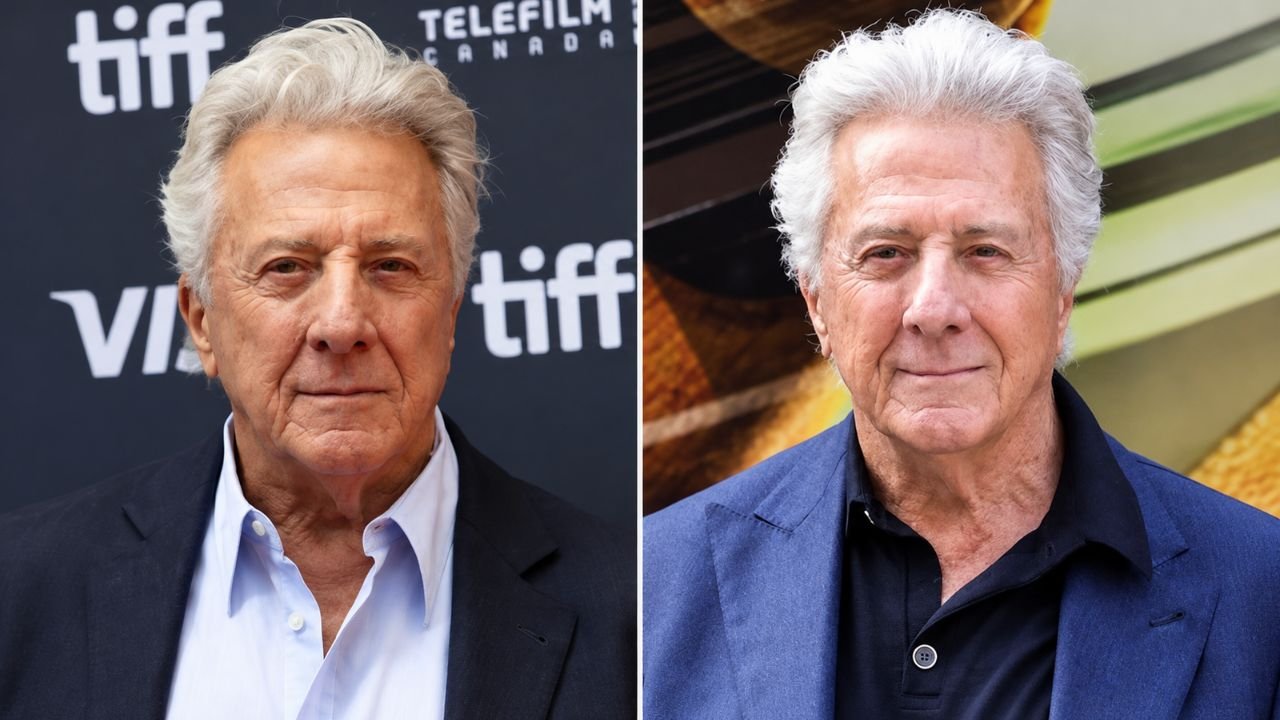
Dustin Hoffman is one of the most respected American actors of his generation, known for choosing challenging characters and bringing unusual depth to both dramatic and comedic performances. Born in Los Angeles in 1937, he spent years working in theater and taking ordinary jobs before Hollywood gave him a major opportunity. His breakthrough as Benjamin Braddock in The Graduate changed the direction of his career and helped establish a different kind of leading man in American cinema. Over the following decades, he appeared in acclaimed films including Midnight Cowboy, Kramer vs. Kramer, Tootsie, Rain Man, All the President’s Men and Little Big Man. His career has continued well beyond the period in which he became famous, covering film, television, theater, voice acting and directing.
Dustin Hoffman Early Life and Family Background
Dustin Lee Hoffman was born on August 8, 1937, in Los Angeles, California. He was the younger of two sons born to Harry Hoffman and Lillian Gold, and his father worked as a prop supervisor at Columbia Pictures before becoming a furniture salesman. His connection to the entertainment industry therefore existed in his family background, although Hoffman did not immediately follow his father into the movie business. He also had an older brother, Ronald, who went on to become a lawyer and economist. Hoffman was named after Dustin Farnum, an actor who worked in stage productions and silent films.
Hoffman grew up in Los Angeles at a time when the city was already closely associated with the American film industry. Despite that environment, acting was not initially an obvious career choice for him. He graduated from Los Angeles High School in 1955 and subsequently attended Santa Monica City College, where he originally considered studying medicine. His direction changed after he became interested in acting and received encouragement to take an acting course. That decision eventually moved him away from a conventional career and toward the profession that would define his life.
Education and the Beginning of His Acting Career
Hoffman’s formal education was not a simple path toward Hollywood success. He spent time at Santa Monica City College and also received training at the Los Angeles Conservatory of Music before studying at the Pasadena Playhouse. The Pasadena Playhouse became particularly important because it connected him with other aspiring performers, including Gene Hackman. Rather than becoming a successful actor immediately, Hoffman spent years developing his skills through theater and smaller opportunities. His eventual success was built on a long period of preparation that is often overlooked when his career is described as a Hollywood breakthrough story.
His early professional years were marked by persistence rather than celebrity. Hoffman worked through a succession of small acting jobs and theater appearances while trying to establish himself. He eventually moved into the New York acting scene, where he continued developing his craft and appeared in stage productions. His theater work earned him recognition before his film career became successful, including an Obie Award for his performance in Journey of the Fifth Horse. These experiences gave him the opportunity to develop the detailed approach to character that later became one of the defining features of his movie career.
Dustin Hoffman Before Hollywood Fame
The years before fame reveal how different Hoffman’s career was from the usual image of an actor who suddenly becomes a star. While pursuing acting, he supported himself through several ordinary jobs, including demonstrating toys at Macy’s, stringing Hawaiian leis and working as an attendant at the New York Psychiatric Institute. These jobs were not glamorous, but they allowed him to continue pursuing theater while making a living. His gradual movement from walk-on appearances to small parts, supporting roles and eventually leading roles took years. By the time Hollywood noticed him, he had already spent a considerable amount of time learning how to work as a professional actor.
Hoffman’s first film appearance came in The Tiger Makes Out, a 1967 black comedy directed by Arthur Hiller. His role was relatively small, but the film gave him his first screen credit during the same period in which his career was about to change dramatically. His next important opportunity came through Mike Nichols, who was searching for an actor to play Benjamin Braddock in The Graduate. That role would transform Hoffman from an experienced theater performer into one of the most recognizable young actors in American cinema. The timing of his film debut and breakthrough also meant that audiences encountered him as a newcomer even though he had already spent years working toward that moment.
The Graduate Changed His Career
The Graduate became the film that established Dustin Hoffman as a major actor. He played Benjamin Braddock, a recent college graduate who finds himself uncertain about what to do with his future and becomes involved in a complicated relationship with an older woman. Hoffman initially did not believe that he was the obvious choice for the role, but director Mike Nichols saw qualities in him that suited the character. His performance gave Benjamin an awkwardness and uncertainty that differed from the confident young heroes often seen in mainstream films. The result was a performance that helped establish a new kind of leading man for the late 1960s.
One remarkable detail about The Graduate is that Hoffman was already 30 when he played the college-age Benjamin. Rather than allowing the age difference to define the performance, he created a character who appeared uncertain, inexperienced and emotionally disconnected from the world around him. The film earned Hoffman his first Academy Award nomination and turned him into an internationally recognized performer. It also led to offers for similar roles involving troubled or disaffected young men. Instead of repeating the same formula, however, Hoffman chose a radically different character for his next major success.
Midnight Cowboy and the Rise of a Character Actor
Midnight Cowboy demonstrated how quickly Hoffman could move away from the image created by The Graduate. He played Enrico “Ratso” Rizzo, a sick and struggling con man who forms an unlikely relationship with Joe Buck, played by Jon Voight. The character was physically unglamorous and emotionally vulnerable, making the role very different from the young college graduate audiences had just seen. Hoffman’s willingness to embrace the character without trying to preserve a conventional movie-star image became one of the strongest signs of his artistic direction. The performance earned him another Academy Award nomination and established him as an actor willing to take major creative risks.
The importance of Midnight Cowboy extended beyond its individual performance. The movie became part of the changing American film culture of the late 1960s, when filmmakers were increasingly willing to explore difficult subjects and unconventional characters. Hoffman fit naturally into this period because he did not depend on the traditional image of a handsome, physically imposing leading man. His approach focused more on behavior, voice, movement and emotional detail. That combination helped make him one of the central performers of the Hollywood Renaissance period.
Dustin Hoffman Movies That Defined His Career
The list of Dustin Hoffman movies includes an unusually broad range of genres and characters. He moved between serious dramas, psychological stories, comedies, crime films, historical productions, family entertainment and animated movies. Instead of establishing one recognizable screen persona and repeating it, he frequently changed his physical mannerisms, voice and behavior to suit each character. This variety became one of the most important characteristics of his career. His major filmography includes several movies that remain widely discussed decades after their original releases.
Some of the most important films in his career include:
- The Graduate
- Midnight Cowboy
- Little Big Man
- Straw Dogs
- Papillon
- Lenny
- All the President’s Men
- Marathon Man
- Kramer vs. Kramer
- Tootsie
- Rain Man
- Ishtar
- Dick Tracy
- Hook
- Wag the Dog
- Finding Neverland
- Meet the Fockers
- The Meyerowitz Stories
- Megalopolis
- Kung Fu Panda
These movies show how difficult it is to reduce Hoffman’s career to one particular genre. He played journalists, fathers, comedians, criminals, historical figures, fictional characters and animated masters. His filmography also demonstrates that he remained willing to work with younger generations of filmmakers and performers long after becoming an established star. Recent listings continue to show acting credits in projects released in the 2020s, reinforcing the longevity of his career.
Little Big Man and His Extraordinary Character Range
Little Big Man gave Hoffman another opportunity to demonstrate how far he could transform himself for a role. He played Jack Crabb, a character whose fictional life stretches across an extraordinary range of ages. The role required Hoffman to portray the character through different stages of life, creating changes in movement, voice and physical presence. It was another example of his willingness to make character transformation more important than conventional screen appearance. The performance further strengthened his reputation for taking unusual and demanding roles.
The movie also illustrates an important aspect of Hoffman’s acting philosophy. He was interested in creating people who appeared to have their own individual behavior rather than simply fitting into familiar movie types. That approach could be seen in both heavily transformed characters and seemingly ordinary men. Whether he was playing an aging historical figure or a father dealing with divorce, he attempted to make the character’s reactions and physical habits feel specific. This attention to individuality became a recurring element throughout his career.
Kramer vs. Kramer and His First Academy Award
Kramer vs. Kramer became one of the most important films of Hoffman’s career. He played Ted Kramer, a father whose marriage breaks down and who suddenly becomes responsible for raising his young son while dealing with a difficult custody dispute. The film gave Hoffman a character much closer to an ordinary person than some of his earlier roles. His performance focused on the emotional changes that occur as Ted learns to become a more involved parent. The role earned him the Academy Award for Best Actor and became his first Oscar-winning performance.
The film also placed Hoffman opposite Meryl Streep, whose performance as Joanna Kramer became an important part of the movie’s emotional conflict. Rather than presenting the divorce as a simple story about one good parent and one bad parent, the film gave both characters understandable motivations. Hoffman’s performance benefited from that complexity because Ted changes substantially throughout the story. The success of Kramer vs. Kramer confirmed that Hoffman could carry a major dramatic film without relying on eccentric character makeup or exaggerated behavior.
Tootsie Showed His Comic Range
Tootsie gave Hoffman one of his most famous comedy roles. He played Michael Dorsey, an actor struggling to find work who decides to disguise himself as a woman named Dorothy Michaels in order to obtain a role on a television soap opera. The premise allowed Hoffman to explore identity, professional insecurity and the entertainment industry’s expectations while also creating an energetic comedy. His performance earned another Academy Award nomination and demonstrated that his dramatic reputation did not prevent him from succeeding in comedy.
The success of Tootsie also showed how effectively Hoffman could use physical behavior to build a character. Michael and Dorothy needed to feel like related but distinct identities, and much of the humor came from the tension between the two. Hoffman’s performance helped keep the character human rather than reducing the disguise to a simple visual joke. The film remains one of the best-known examples of his ability to combine serious acting techniques with mainstream entertainment.
Rain Man Earned His Second Oscar
Rain Man brought Hoffman his second Academy Award for Best Actor. He played Raymond Babbitt, an autistic savant whose relationship with his younger brother Charlie becomes the center of the story. Tom Cruise played Charlie, creating a contrast between the two brothers and allowing the film to explore family relationships, responsibility and emotional connection. Hoffman’s performance relied heavily on carefully controlled speech, movement and behavior to create Raymond as a distinct individual. The role became one of the most recognizable performances of his career.
The success of Rain Man added another major achievement to a career that had already included one Oscar. It also demonstrated that Hoffman could remain a central box-office attraction while playing a character who did not fit conventional ideas about a leading man. The film won multiple Academy Awards and became a major cultural success. For Hoffman, it represented another stage in a career built around taking characters seriously rather than simply using them as vehicles for celebrity.
Other Notable Dustin Hoffman Movies
Hoffman’s filmography continued to expand throughout the 1990s and 2000s. He played Captain Hook in Hook, appeared in Dick Tracy and Wag the Dog, and later took supporting roles in movies such as Finding Neverland and The Meyerowitz Stories. His later work also included comedies such as Meet the Fockers and animated projects such as Kung Fu Panda. These roles allowed him to reach audiences who may have known him primarily from his earlier dramatic performances.
His voice performance as Master Shifu in the Kung Fu Panda series became particularly important to his later popular appeal. The character gave Hoffman an opportunity to use his distinctive voice while working within an animated world rather than relying on his physical presence. He returned as Shifu in several installments of the franchise, including Kung Fu Panda 2, Kung Fu Panda 3 and Kung Fu Panda 4. The series demonstrated that his career could continue connecting with audiences through very different forms of entertainment.
Dustin Hoffman on Stage and Television
Although his film career is usually the focus of public attention, theater remained an important part of Hoffman’s professional identity. He made his Broadway debut in A Cook for Mr. General in 1961 and continued working on stage during different periods of his career. His theater credits include productions such as Jimmy Shine and Death of a Salesman. He also played Shylock in The Merchant of Venice, earning a Tony Award nomination for his performance.
Death of a Salesman was especially significant because Hoffman had encountered Arthur Miller’s play when he was young and later took on the role of Willy Loman. His 1984 Broadway performance became one of his important stage achievements, and he later reprised the character for television. The television version earned him a Primetime Emmy Award as well as a Golden Globe. His work on the stage therefore forms an important part of his career rather than being simply a period before his movie success.
Dustin Hoffman as a Director
Hoffman expanded his creative work behind the camera with Quartet, released in 2012. The film marked his directorial debut and featured an ensemble cast that included Maggie Smith, Michael Gambon, Billy Connolly and Tom Courtenay. The story centered on retired musicians living in a home for professional performers and combined comedy with themes of aging, friendship and artistic identity. Directing the film gave Hoffman another way to participate in filmmaking after decades spent primarily in front of the camera.
Quartet was also consistent with the type of human stories that had characterized much of Hoffman’s acting career. Instead of focusing on spectacle, the film placed its characters and their relationships at the center. His decision to direct later in his career demonstrated that his interest in filmmaking extended beyond acting. It also added another dimension to his professional legacy, showing that he was willing to take on a new creative responsibility even after establishing himself as an internationally recognized actor.
Dustin Hoffman and Lisa Hoffman
Dustin Hoffman’s personal life has also attracted public interest because of his long marriage to Lisa Gottsegen, who is known professionally as Lisa Hoffman. The couple married on October 12, 1980, after Hoffman’s first marriage to Anne Byrne ended earlier that year. Dustin and Lisa have four children together: Jacob, Rebecca, Maxwell and Alexandra. Hoffman also has two children from his first marriage, giving him six children in total.
Lisa Hoffman has built her own professional identity as a beauty entrepreneur and founder of Lisa Hoffman Beauty. Her career and business interests are separate from her husband’s acting work, although the couple have remained connected for decades. This makes their family story particularly interesting because both have established recognizable professional identities in different fields. For a celebrity biography, their relationship is best presented as part of Hoffman’s family life rather than as a substitute for his much larger professional story.
Dustin Hoffman Children and Family
Dustin Hoffman has six children, including Jake Hoffman, who followed his father into the entertainment industry. His children come from his two marriages, with four born during his marriage to Lisa Gottsegen and two from his earlier relationship with Anne Byrne. The family has generally maintained a lower public profile than many celebrity families, although some members have pursued careers connected to film and entertainment. Jake Hoffman is particularly recognizable because of his work as an actor, director and writer.
The family connection adds another layer to the story of Hoffman’s career. Unlike an actor whose professional legacy ends with one generation, Hoffman has seen members of his family become involved in creative work themselves. His long marriage to Lisa and his relationships with his six children are therefore relevant to understanding his life outside the screen. They should, however, remain secondary to his acting career when the article is primarily about his professional achievements.
Dustin Hoffman and Tiger Woods: What Is the Connection?
The phrase Dustin Hoffman and Tiger Woods appears in searches because the two have been connected through social and sporting circles rather than through the entertainment industry. A reported 2017 golf gathering involving Donald Trump, Tiger Woods and Dustin Hoffman brought the actor and professional golfer together in a recreational setting. This does not establish that Hoffman and Woods had a close personal friendship or a long-term professional relationship. The safest way to discuss the subject is therefore to describe the documented connection without exaggerating it.
There is also a separate connection through New York’s famous San Remo residential building, which has been associated with a number of notable residents. Tiger Woods and Dustin Hoffman have both been linked with the building in coverage of its celebrity residents. This is an interesting search-related detail, but it should remain a small part of the biography rather than becoming a central theme. The primary focus of a Dustin Hoffman article should remain his acting, films, family and long career.
Dustin Hoffman Awards and Major Honors
Hoffman’s awards history reflects the range of his work across film, television and theater. He won Academy Awards for Kramer vs. Kramer and Rain Man, while receiving additional Oscar nominations for several other performances. The Golden Globes record lists 13 nominations and five wins, including recognition for The Graduate, Kramer vs. Kramer, Tootsie, Rain Man and Death of a Salesman. His career has therefore been recognized repeatedly across different decades and genres.
Some of the most important honors associated with his career include:
- Two Academy Awards
- Five Golden Globe wins from 13 nominations
- Four BAFTA Awards
- Two Emmy Awards
- AFI Life Achievement Award in 1999
- Cecil B. DeMille Award in 1997
- Kennedy Center Honors in 2012
- Honorary César recognition
- Multiple Drama Desk Awards
- Tony Award nomination
The AFI Life Achievement Award was especially significant because it recognized Hoffman’s overall contribution to American cinema rather than a single performance. The Kennedy Center Honors later acknowledged his wider contribution to American culture through the performing arts. These honors help explain why his reputation extends beyond individual box-office successes or Oscar-winning roles. His standing comes from the combination of longevity, range and influence across several forms of performance.
Dustin Hoffman’s Acting Style and Legacy
One of the most distinctive features of Hoffman’s career is his willingness to disappear into characters. The American Film Institute describes him as an actor who emphasized realism and individuality, often creating characters with their own movements, voices and behavioral patterns. This approach allowed him to play people who looked and behaved very differently from one another without depending entirely on makeup or physical transformation. His performances frequently give the impression that the character existed before the story began.
Hoffman’s reputation for perfectionism is closely connected to this approach. He has been known for examining small elements of a performance in an effort to make a character more convincing and emotionally believable. That commitment sometimes became part of his public image, but it also helped produce performances that remain widely studied and remembered. His career demonstrates that technical preparation and emotional observation can coexist with mainstream movie success.
Dustin Hoffman’s Later Career
Hoffman did not disappear after the major successes of the 1970s and 1980s. During the 1990s and 2000s, he continued appearing in major productions while increasingly accepting supporting and ensemble roles. His later film work included Finding Neverland, Stranger Than Fiction, Meet the Fockers, Last Chance Harvey and The Meyerowitz Stories. He also became a familiar voice to younger audiences through the Kung Fu Panda movies.
His recent credits show that his career has remained active well into his later years. Current film listings include projects such as Megalopolis, Kung Fu Panda 4, Tuner and Diamond, with additional 2026 listings appearing in film databases. This makes it inaccurate to describe Hoffman simply as a retired Hollywood star whose important work ended decades ago. Instead, his career is better understood as an unusually long creative journey that has moved through different periods of American filmmaking.
Why Dustin Hoffman Remains Important to Hollywood
Hoffman’s importance comes from more than the number of awards attached to his name. He became one of the actors associated with a period when American cinema moved toward more complicated characters and stories. His success demonstrated that a leading actor did not have to fit the traditional physical image of a Hollywood star. By succeeding in roles involving uncertainty, vulnerability, eccentricity and moral complexity, he helped broaden expectations for leading performances.
His filmography also provides a useful record of how American cinema changed over several decades. He worked with directors including Mike Nichols, Arthur Penn, Sam Peckinpah, Alan J. Pakula, Robert Benton, Sydney Pollack and Barry Levinson. He moved between serious dramas, dark comedies, mainstream entertainment and animated films without becoming permanently associated with a single genre. That ability to change direction is one of the strongest reasons his career remains relevant to audiences and film historians.
Frequently Asked Questions
How old is Dustin Hoffman?
Dustin Hoffman was born on August 8, 1937, in Los Angeles, California. As of 2026, he is 89 years old. His professional career has extended from the early 1960s into the 2020s, making him one of the longest-working major American actors. His recent film credits show that his screen career has continued well beyond the period of his earliest classics.
What are Dustin Hoffman’s most famous movies?
Some of Dustin Hoffman’s best-known movies include The Graduate, Midnight Cowboy, Little Big Man, All the President’s Men, Kramer vs. Kramer, Tootsie and Rain Man. Other notable films include Straw Dogs, Papillon, Marathon Man, Hook, Wag the Dog, Finding Neverland and The Meyerowitz Stories. He also became widely recognized by younger audiences for voicing Master Shifu in the Kung Fu Panda series. His filmography covers several genres and generations of American cinema.
How many Oscars has Dustin Hoffman won?
Dustin Hoffman has won two Academy Awards for Best Actor. His first win came for Kramer vs. Kramer in 1980, recognizing his performance as Ted Kramer, while his second came for Rain Man in 1989 for his portrayal of Raymond Babbitt. He also received Oscar nominations for The Graduate, Midnight Cowboy, Lenny, Tootsie and Wag the Dog. These nominations demonstrate the sustained critical recognition he received across different periods of his career.
Who is Dustin Hoffman’s wife?
Dustin Hoffman’s wife is Lisa Gottsegen, who is also known professionally as Lisa Hoffman. The couple married on October 12, 1980, and have four children together. Hoffman was previously married to Anne Byrne, with whom he has two children, bringing his total number of children to six. Lisa has also established her own career as a beauty entrepreneur and founder of Lisa Hoffman Beauty.
What is the connection between Dustin Hoffman and Tiger Woods?
Dustin Hoffman and Tiger Woods have been connected through reported social and recreational events rather than through a shared professional career. A 2017 report about a golf gathering involving Woods and Hoffman helped create public interest in the connection. Both names have also appeared in coverage concerning notable residents associated with New York’s San Remo building. There is no strong basis for presenting the two as long-term professional partners or close personal friends, so the connection should be described cautiously.
Conclusion
Dustin Hoffman built his career by taking a route that was very different from the conventional Hollywood success story. He spent years studying, performing on stage and working ordinary jobs before The Graduate introduced him to a worldwide audience. From Ratso Rizzo and Jack Crabb to Ted Kramer, Michael Dorsey and Raymond Babbitt, he repeatedly chose characters that demanded something different from him. His two Academy Awards represent only part of a career that includes major theater work, television recognition, directing and memorable voice performances.
The story of Dustin Hoffman is ultimately a story about range and persistence. His movies helped change ideas about what a Hollywood leading man could look and behave like, while his detailed approach to acting allowed him to move between completely different characters. His long marriage to Lisa Hoffman and his six children add another dimension to his life away from the screen. With film credits continuing into the 2020s, his career remains a significant part of American cinema history and continues to give audiences new reasons to revisit his work.