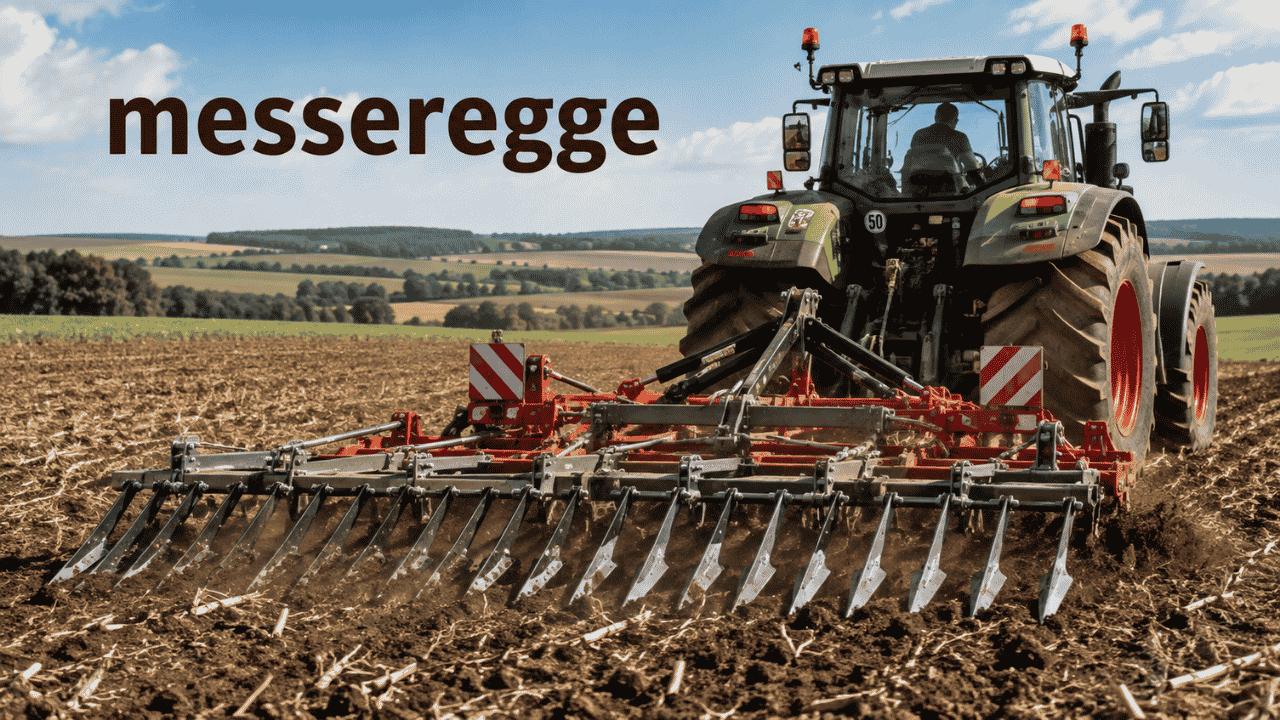
The word messeregge has become an unusual search term because it appears in online content with more than one interpretation. Some sources connect it with German agricultural terminology and describe it in relation to a knife or blade harrow, while other pages associate the word with exhibition design, digital tools, or even a supposed destination in Austria. This makes a simple definition difficult to give without looking at the context in which the word is being used. A useful explanation therefore needs to separate the established agricultural meaning from newer or less clearly supported interpretations found online.
What Does messeregge Mean?
The most recognizable interpretation of messeregge comes from German agricultural terminology. The word can be understood by looking at its two parts, with Messer referring to a knife or blade and Egge referring to a harrow. In this context, messeregge describes agricultural equipment associated with cutting or working the upper layer of soil. The term is therefore closely connected with field preparation and shallow soil cultivation rather than being a general word for an ordinary household knife.
The agricultural meaning is especially useful because it gives the word a practical context. Farmers use different types of harrows and cultivation equipment depending on soil conditions, crop residue, seedbed requirements, and the amount of soil disturbance they want. A blade-based implement can perform a different job from equipment that relies on discs or heavy teeth. Understanding this distinction helps explain why messeregge appears in discussions about agricultural machinery and soil preparation.
The Agricultural Meaning of messeregge
In farming, a messeregge can be understood as a tool designed to work the soil using knife-like or blade elements. Its action is generally associated with shallow cultivation, where the goal is to work the surface rather than perform deep ploughing. Depending on the particular machine and its configuration, such equipment may help cut surface material, disturb the upper soil layer, or prepare the field for a later operation. The exact performance depends on the design of the implement, the working depth, the soil condition, and the way the machine is operated.
The role of shallow cultivation is important in modern field management. Farmers often need to balance soil disturbance with the practical need to prepare a field, manage residues, or create suitable conditions for planting. Heavy cultivation can require more energy and can disturb more soil than necessary for certain operations. A tool designed for a shallower working action can therefore have a specific place in a wider cultivation system.
Common agricultural purposes
The exact use of a messeregge depends on its construction, but agricultural applications associated with this type of equipment can include:
- Shallow cultivation of the upper soil layer
- Cutting or disturbing surface residues
- Preparing or leveling the seedbed
- Breaking surface crusts under suitable conditions
- Supporting field preparation before planting
- Working crop residue near the soil surface
These applications should not be treated as a fixed list for every machine carrying the same terminology. Agricultural implements can differ significantly in blade arrangement, frame design, working width, depth control, and intended operating conditions. A machine designed for one soil type or farming system may not produce the same result in another situation. This is why technical specifications should always be considered when identifying a particular piece of equipment.
How a messeregge Works
The basic principle behind a messeregge is easier to understand when compared with deeper cultivation equipment. Instead of turning over a large volume of soil, blade-based elements can work closer to the surface and cut through the material they encounter. The implement is pulled across the field by a tractor or another suitable machine, allowing the working elements to contact the soil continuously. The result depends on factors such as speed, soil moisture, working depth, blade design, and field conditions.
Surface conditions can make a significant difference to the result. Soil that is too wet may behave differently from dry or compacted soil, while heavy residue can change how the blades move through the field. Operators therefore need to select settings that match the conditions rather than assuming that the same adjustment will work everywhere. Proper setup can influence both the quality of the field finish and the amount of unnecessary soil disturbance.
messeregge Compared With a Traditional Harrow
A traditional harrow can use teeth, tines, spikes, springs, or other working elements to break up and level the soil. A messeregge, by comparison, is associated with a knife or blade-style working action. The difference is not simply a matter of appearance because the working element affects how the implement interacts with the soil and plant residue. The most appropriate machine depends on the task the farmer wants to accomplish.
For a simple comparison, consider these characteristics:
- A traditional harrow commonly uses teeth or tines.
- A messeregge is associated with knife or blade elements.
- Both can be used for surface-level field preparation.
- Working depth can vary according to machine design and settings.
- Soil type and moisture can influence the result of both systems.
- Neither implement is automatically suitable for every cultivation job.
The comparison becomes more useful when the actual purpose of the operation is considered. A farmer interested in leveling, light surface disturbance, residue management, or seedbed preparation may evaluate several implements before choosing one. Cost, tractor requirements, field size, working width, maintenance, and local soil conditions can all influence the decision. The name of the implement alone is not enough to determine whether it is the right choice.
messeregge Compared With a Disc Harrow
A disc harrow works with rotating discs that cut and move through the soil. The discs can create a different pattern of soil movement compared with knife-like elements used by equipment associated with the term messeregge. Disc harrows are available in many configurations, from relatively light machines to heavier implements designed for more intensive soil work. The correct comparison therefore depends on the particular models being considered.
The main difference is the way the working components interact with the field. A blade or knife arrangement can provide a cutting action near the soil surface, while discs rotate and move soil as they pass through it. Neither approach should automatically be described as better because farming requirements differ from one field to another. The best choice depends on the desired working depth, residue conditions, soil structure, available tractor power, and the intended field operation.
Why the Meaning of messeregge Is Confusing Online
The biggest challenge with this keyword is that not every page using messeregge appears to be discussing the same thing. Current search results include pages that treat it as an agricultural term, while others introduce unrelated concepts or interpretations. This can happen when an unusual word has limited established information and publishers begin creating content around different possible meanings. Once several interpretations appear online, readers can easily assume that all of them are equally established.
Another source of confusion is the similarity between German words. Messer and Messe do not have the same meaning, even though they look similar at the beginning. Messer relates to a knife, while Messe can refer to a trade fair or exhibition depending on the context. Mixing these terms can lead to explanations that sound plausible but do not accurately represent the original German terminology.
The Trade Show Interpretation
Some online content connects messeregge with exhibition or trade-show design. This interpretation presents the term in connection with structures, displays, framing, or ways of organizing exhibition spaces. It is worth mentioning because it appears in current search results, but readers should be careful about treating this interpretation as a universally recognized German definition. A niche usage found on a website does not automatically establish a word as standard terminology.
When researching an unusual keyword, it helps to distinguish between a documented term and a meaning created or promoted by a particular website. If an interpretation appears only on pages connected to one commercial concept, it deserves additional verification before being presented as an established definition. This approach is especially useful when writing an informational article intended to provide reliable information rather than simply reproduce existing search results.
Is messeregge a Digital Concept?
Another interpretation appearing online describes messeregge as a philosophy associated with digital tools and simple, precise online experiences. In that context, the word is presented as an idea involving efficiency, simplicity, and focused functionality. This is an interesting use of the keyword, but it should be separated from the agricultural meaning. There is a major difference between saying that a website uses messeregge as a concept and saying that the German word universally means a digital philosophy.
Readers searching for the keyword may therefore encounter very different explanations depending on which result they open. A responsible article should identify this distinction rather than combining unrelated meanings into one definition. The digital interpretation can be mentioned as a current online usage while making clear that it does not replace the agricultural terminology. This distinction also explains why search results for messeregge can look inconsistent.
The Austrian Destination Interpretation
One of the current online results presents messeregge as a destination associated with Austrian landscapes and outdoor activities. That page discusses scenery, hiking, lakes, villages, skiing, accommodation, and travel-related subjects. This creates another possible interpretation for people who encounter the keyword through travel content rather than agricultural information. However, claims about a specific place should be independently verified before being presented as established geographic information.
This is an important lesson when researching obscure keywords. A website can create a detailed article around a name without that article proving that the name represents a widely recognized destination. Maps, official tourism sources, geographic databases, and local government information are stronger evidence for confirming a place name. Until that verification is available, the Austrian interpretation is better described as an online claim rather than presented as the unquestioned meaning of messeregge.
How to Research an Unusual Term Like messeregge
Researching a rare keyword requires more than reading the first page that appears in a search engine. When different websites provide contradictory explanations, compare the terminology, the sources behind each claim, and the context in which the word is being used. A good article should also distinguish between direct evidence and interpretations created by individual publishers. This prevents one unsupported definition from becoming repeated across the internet simply because several websites copied one another.
A useful research process includes:
- Check established dictionaries and terminology databases.
- Search the original language rather than relying only on English pages.
- Compare agricultural, geographic, commercial, and technical uses separately.
- Look for independent sources supporting unusual claims.
- Check whether a claimed location appears on reliable maps or official websites.
- Avoid treating repeated claims as proof when the same information originates from one page.
- Explain uncertainty instead of filling gaps with speculation.
This approach is particularly useful for SEO content because search engines can already find pages that repeat the same information. A stronger article gives readers something those pages do not provide, such as clear distinctions between meanings, practical comparisons, and an explanation of why the search results disagree.
Which Meaning of messeregge Should Readers Trust?
The agricultural interpretation has the clearest linguistic connection because Messer and Egge correspond directly with the idea of a knife or blade and a harrow. It provides a practical explanation that fits the way German agricultural terminology is formed. The other interpretations may represent newer, specialized, commercial, or website-specific uses, but they should not automatically be treated as equivalent to the traditional agricultural meaning. Context is therefore essential when deciding what messeregge refers to.
If someone encounters the word in an agricultural machinery catalog or farming discussion, the agricultural interpretation is the logical starting point. If it appears on a website discussing digital tools, the publisher may be using the word in a specialized way. Likewise, a travel page may be using it as a geographical name or claimed destination. Looking at the surrounding subject is the simplest way to understand which interpretation is intended.
Why Context Matters When Understanding messeregge
Rare words are often more difficult to interpret because readers cannot rely on common usage. A familiar term usually has a stable meaning that remains recognizable across different websites, but an obscure keyword can be used in several ways. This is especially true when the word appears in different languages, industries, or online communities. For messeregge, context provides an important clue that prevents unrelated definitions from being mixed together.
The context also matters for anyone writing content about the keyword. An article focused entirely on agriculture would miss the fact that current search results contain other interpretations. On the other hand, an article that treats every online claim as equally valid could leave readers with an inaccurate understanding of the term. The best approach is to explain the strongest meaning first and then discuss the other interpretations with appropriate caution.
Frequently Asked Questions About messeregge
What does messeregge mean?
messeregge is most closely associated with German agricultural terminology involving a knife or blade harrow. The word can be understood through its German components, with Messer relating to a knife and Egge referring to a harrow. In farming contexts, it describes equipment associated with shallow soil work and a cutting action. Other online pages use the word in different contexts, so the surrounding subject should always be checked.
Is messeregge an agricultural tool?
Yes, the agricultural interpretation connects messeregge with a knife or blade-based harrow used for field cultivation. Its purpose can include working the upper layer of soil, cutting surface material, and supporting field preparation. The exact function depends on the design and operating conditions of the particular implement. It should not automatically be confused with every type of harrow or cultivation machine.
What is a messeregge used for?
A messeregge can be associated with shallow soil cultivation, surface residue management, seedbed preparation, and other field operations depending on its configuration. Its knife-like working elements distinguish it from equipment that relies primarily on discs or conventional teeth. Soil moisture, working depth, speed, and machine design all affect the result. Farmers therefore need to match the implement to the specific field conditions.
Is messeregge the same as a disc harrow?
No, the two terms describe different types of working systems. A disc harrow uses rotating discs, while a messeregge is associated with knife or blade elements. Their soil action, residue handling, working depth, and field performance can therefore differ. The right option depends on the operation, soil, residue, tractor capacity, and desired result.
Why does messeregge have different meanings online?
The keyword appears in content covering agriculture, digital concepts, exhibition-related ideas, and a claimed Austrian travel interpretation. Some of these uses may be specialized or website-specific rather than established meanings of the German word. That is why search results can appear contradictory when someone searches only for the keyword. Checking the context and the reliability of the source is the best way to separate established terminology from newer claims.
Conclusion
messeregge is an unusual keyword because its online meaning is not consistent across every page that uses it. Its strongest and most understandable traditional interpretation is connected with German agricultural terminology and a knife or blade harrow used for shallow field work. At the same time, current search results introduce other interpretations involving digital tools, exhibition concepts, and a claimed Austrian destination. These should be treated according to the quality of the evidence behind them rather than being combined into one definition.
For anyone researching messeregge, context is the key. An agricultural machinery page, a digital-tool website, and a travel article may all use the same word while referring to completely different ideas. A careful explanation should identify those differences, give the agricultural meaning its proper context, and clearly label claims that require further verification. That approach gives readers a more useful understanding of messeregge than simply repeating whichever definition happens to appear first in search results.