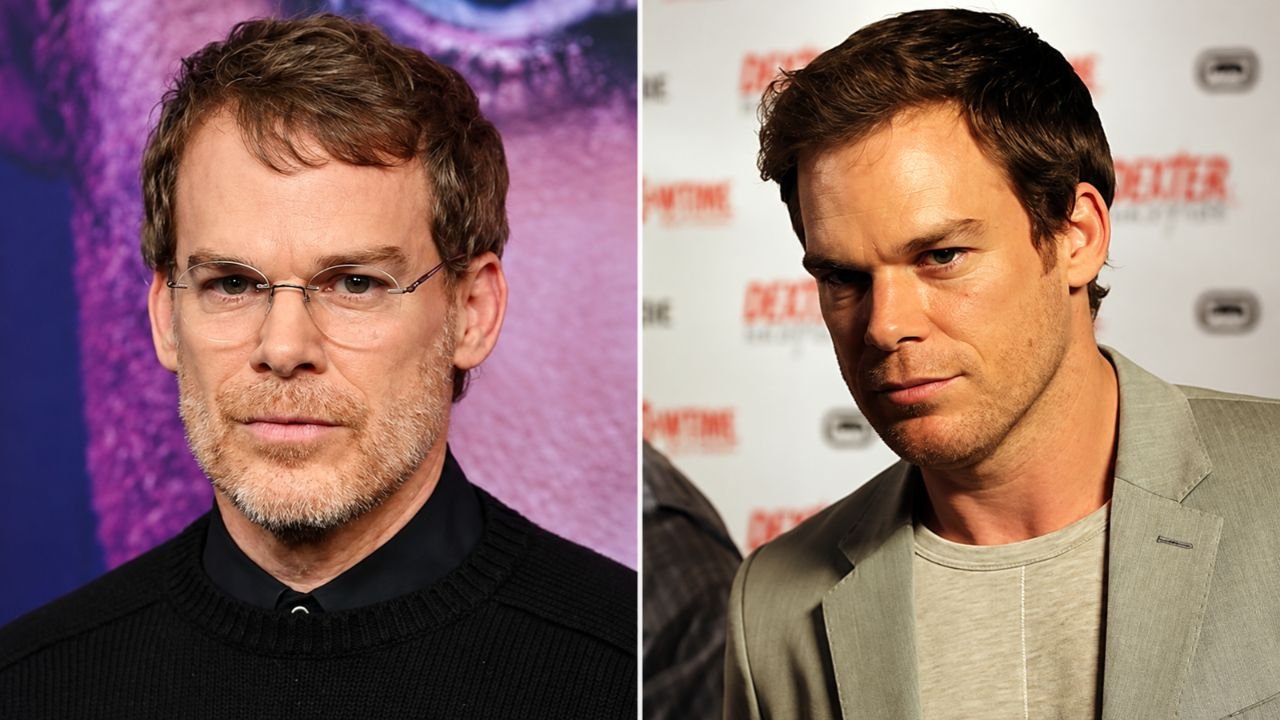
Michael C. Hall has built a career around characters who are rarely easy to understand. From the emotionally conflicted David Fisher in Six Feet Under to the secretive Dexter Morgan, he has repeatedly taken on roles that require restraint, vulnerability, and psychological depth. His career, however, extends well beyond the television screen, with major work in Broadway productions, off-Broadway theater, films, and music. Today, Hall remains closely associated with Dexter while continuing to explore new creative directions as an actor, producer, stage performer, and musician.
Michael C. Hall Early Life and Family Background
Michael Carlyle Hall was born on February 1, 1971, in Raleigh, North Carolina. He grew up in a family that was not primarily connected to the entertainment industry, although his parents supported his early interests and education. His father, William Carlyle Hall, worked for IBM, while his mother, Janice Hall, worked as a counselor. Hall experienced the loss of his father from prostate cancer when he was only 11, an event that became an important part of his childhood.
Long before he became known as a television actor, Hall developed an interest in performance while attending school. He participated in a boys’ choir and later became involved in school productions and musicals. His early performances included productions such as The Sound of Music, Oklahoma!, and Fiddler on the Roof. He also participated in a chamber choir that traveled to Austria, giving him an early experience of performing outside his hometown.
His Interest in Performance Developed Gradually
Acting was not always Hall’s planned career. During his younger years, he expected that he might eventually become a lawyer, and his first college experience was not initially centered entirely around professional acting. While studying at Earlham College, however, he became increasingly interested in theater and began taking acting classes. His growing involvement in performance eventually changed the direction of his professional life.
Hall graduated from Earlham College in 1993 and subsequently moved to New York City to pursue advanced acting training. He enrolled at New York University’s Tisch School of the Arts, where he earned a Master of Fine Arts degree in 1996. His formal theater education gave him a strong foundation for the stage and prepared him for a career that would initially develop more through theater than television.
Michael C. Hall’s Early Theater Career
Before television made him internationally recognizable, Michael C. Hall spent years building his reputation in New York theater. He appeared in several Shakespearean productions, including Macbeth, Cymbeline, Henry V, and Timon of Athens. He also worked in productions such as Corpus Christi and other off-Broadway projects. These early roles helped him develop the controlled performance style that later became one of his strengths on television.
One particularly interesting part of Hall’s early career involved the musical Bounce, which was associated with composer Stephen Sondheim and director Sam Mendes. The production was later known as Wise Guys, and although it did not immediately become a major mainstream success, the experience connected Hall with important figures in American theater. That relationship eventually became significant because Mendes would later have a connection to Six Feet Under creator Alan Ball. This illustrates how Hall’s career developed through a series of theater relationships rather than one sudden breakthrough.
Broadway and Cabaret
Hall made an important Broadway appearance in the 1999 revival of Cabaret. He took over the role of the Emcee, following Alan Cumming in the production. The role gave him an opportunity to demonstrate a very different side of his performance abilities, particularly his ability to combine theatrical confidence with darker and more complicated material.
His Broadway experience continued with other productions, including Chicago and The Realistic Joneses. He also returned to the stage in later years through productions such as Hedwig and the Angry Inch and Lazarus. His continuing relationship with theater is important because it shows that his career was never limited to television acting.
Theater Roles That Shaped His Career
Some of the major stage productions associated with Hall include:
- Cabaret
- Chicago
- The Realistic Joneses
- Hedwig and the Angry Inch
- Lazarus
- Thom Pain (based on nothing)
- Macbeth
- Cymbeline
- Henry V
- Timon of Athens
The variety of these productions demonstrates the range of his theatrical work. He moved between classic plays, musicals, contemporary drama, and experimental productions. This background later helped him approach television characters with a level of physical and emotional control that became especially useful in Dexter.
Michael C. Hall and Six Feet Under
Hall’s major television breakthrough arrived with Six Feet Under in 2001. He was cast as David Fisher, one of the central members of a family running a funeral home in Los Angeles. David was a deeply complicated character whose story explored family pressure, personal identity, relationships, responsibility, and emotional vulnerability. The role established Hall as a serious dramatic actor before he became internationally famous as Dexter Morgan.
Six Feet Under ran for five seasons and became one of the most respected dramas of its period. Hall’s performance earned an Emmy nomination, while the ensemble received recognition from the Screen Actors Guild. His portrayal of David Fisher was particularly important because the character required him to communicate internal conflict without always expressing it openly. That restrained approach became one of the defining qualities of Hall’s later performances.
David Fisher Was an Important Career Foundation
The role of David Fisher allowed Hall to demonstrate that he could carry emotionally demanding material over multiple seasons. David’s relationship with his family was complicated, and his personal struggles were often placed against the responsibilities of running the family business. Hall had to balance quiet scenes with moments of intense emotional confrontation. The experience gave him the television discipline that would later become essential when he took on the much more demanding role of Dexter.
Hall did not simply move from one television success to another. After Six Feet Under ended, he continued working in theater and other projects while looking for his next significant role. His decision to wait for material that interested him helped make the transition to Dexter especially significant. Rather than being known for only one type of dramatic performance, he entered his next major series with an established reputation as a versatile actor.
How Michael C. Hall Became Dexter Morgan
In 2006, Hall took on the role that would define much of his career. Dexter Morgan was introduced as a blood-spatter analyst working for the Miami Metro Police Department who secretly killed people he believed deserved punishment. The character presented an unusual challenge because Dexter needed to appear socially ordinary while concealing an extremely dark private life.
The original Dexter series premiered on October 1, 2006, and continued for eight seasons through 2013. Hall’s performance required him to communicate much of Dexter’s thinking through voice-over narration, facial expressions, body language, and subtle changes in behavior. The character could appear calm and detached in one scene and intensely threatening in another, often without making the transition obvious to the people around him.
Why Dexter Became Such a Defining Role
Dexter Morgan was unlike David Fisher in almost every obvious way. David was dealing with family expectations and emotional vulnerability, while Dexter was deliberately hiding his true nature from nearly everyone around him. Yet both roles depended heavily on Hall’s ability to communicate complicated emotions beneath a controlled exterior. That similarity helped explain why he could make Dexter believable rather than turning the character into a simple villain.
The success of Dexter transformed Hall into an internationally recognized television star. His performance earned numerous award nominations and several major wins, including a Golden Globe and a Screen Actors Guild Award. He also received repeated Primetime Emmy nominations for Outstanding Lead Actor in a Drama Series. According to biographical records, his six nominations in that specific category became notable because of the number of nominations he accumulated without winning the individual award.
Michael C. Hall’s Career Beyond Dexter
Although Dexter became his signature role, Hall continued to work in a wide range of films and television projects. His filmography includes productions such as Paycheck, Gamer, Kill Your Darlings, Cold in July, Christine, Mark Felt: The Man Who Brought Down the White House, Game Night, The Report, In the Shadow of the Moon, and John and the Hole. These projects allowed him to move between crime stories, dramas, thrillers, comedy, and independent cinema.
His television work also demonstrates that he has not depended entirely on one franchise. Hall appeared in The Crown as John F. Kennedy and took roles in projects including Safe, The Defeated, and Documentary Now!. He has also contributed voice performances to animated productions. These appearances helped keep his career varied during periods when he was not playing Dexter.
Selected Film and Television Work
Some notable projects from Hall’s screen career include:
- Six Feet Under
- Dexter
- The Crown
- Safe
- The Defeated
- Documentary Now!
- Paycheck
- Gamer
- Kill Your Darlings
- Cold in July
- Christine
- Game Night
- The Report
- In the Shadow of the Moon
- John and the Hole
Rather than following a straightforward path from television into blockbuster movies, Hall has repeatedly moved between mainstream productions and more unusual projects. That pattern is consistent with his theater background, where actors frequently move between different types of productions. His film choices also demonstrate a willingness to play characters who are very different from Dexter Morgan.
Michael C. Hall’s Return to Dexter
The story of Dexter did not permanently end with the conclusion of the original series. Hall returned to the character in Dexter: New Blood, which brought Dexter Morgan back to television after the original series had concluded. The revival placed the character in a very different environment and gave Hall the opportunity to explore how Dexter had changed after years away from Miami.
Hall’s involvement expanded further with Dexter: Original Sin, a prequel exploring Dexter’s younger years. Patrick Gibson played the younger version of Dexter, while Hall provided the character’s inner voice. This allowed Hall to remain part of the franchise even though he was not physically portraying the younger version of the character.
The franchise then moved into another chapter with Dexter: Resurrection. Hall returned physically as Dexter Morgan, once again placing him at the center of the story. Paramount+ describes the series as following Dexter after he awakens from a coma and travels to New York City in search of his son Harrison.
Dexter: Resurrection and the New York Setting
Dexter: Resurrection gave Hall an opportunity to play the character in a substantially different setting. Instead of the familiar atmosphere of Miami, the story moved toward New York City, creating a darker and more urban environment. Hall has described the difference between the two settings in terms of their visual and emotional qualities, noting the contrast between Miami’s softer, humid atmosphere and New York’s harder edges and concrete surroundings.
The change is more than a location switch because it changes the way Dexter interacts with the world around him. The crowded environment of New York creates new opportunities for danger, anonymity, and confrontation. At the same time, his relationship with Harrison becomes increasingly important to the story. This allows Hall to explore Dexter not simply as a killer but as a father attempting to understand what remains of his relationship with his son.
Michael C. Hall in Dexter: Resurrection Season 2
The second season of Dexter: Resurrection is particularly important for Hall because the character is now at a different point in his life. Paramount+ has confirmed that Season 2 premieres on October 30, 2026, with Hall returning as Dexter Morgan and continuing as an executive producer. The season also brings back Jack Alcott as Harrison and Uma Thurman, while adding actors including Brian Cox and Dan Stevens as series regulars.
Hall has described this stage of Dexter’s life as an unexpected development for the character. In a recent interview, he explained that Dexter never really imagined reaching this point in his life and that the writers have been able to take him in directions Hall himself did not expect. The character’s changing perspective creates tension between his desire to remain hidden and a new desire to be recognized or appreciated.
Season 2 also introduces a different kind of conflict for Dexter. Rather than simply dealing with external enemies, the character is facing questions about aging, identity, purpose, and his complicated relationship with Harrison. The official Season 2 material describes Dexter as being caught between two killers while simultaneously dealing with an unexpected midlife crisis.
A Major Dexter Anniversary
The timing of the new season is significant because 2026 marks 20 years since Dexter first premiered. Paramount+ has highlighted October 1, 2026, as the twentieth anniversary of the original series. Two decades after Hall first introduced audiences to Dexter Morgan, the actor is still playing the same character in a continuing television universe.
The franchise now includes four connected television series:
- Dexter
- Dexter: New Blood
- Dexter: Original Sin
- Dexter: Resurrection
Hall physically portrays Dexter in the original series, New Blood, and Resurrection. In Original Sin, his involvement comes through the character’s inner voice, creating a connection between the prequel and the earlier productions.
Michael C. Hall’s Work in Music
Acting is only one part of Hall’s creative career. His work in theater eventually led to a significant musical partnership with musicians Matt Katz-Bohen and Peter Yanowitz. The three became connected through Hedwig and the Angry Inch, and they eventually formed the band Princess Goes. Hall serves as the group’s lead vocalist and songwriter.
Princess Goes gave Hall an opportunity to explore music independently from his acting career. The group released its debut EP before releasing the album Thanks for Coming in 2021. A later album, Come of Age, followed in 2023. The band has also performed live and developed an audience separate from Hall’s television work.
From Hedwig to Princess Goes
Hall’s connection with music was not a sudden decision made after becoming famous. Theater had already placed him in productions where music and acting overlapped, particularly Hedwig and the Angry Inch. Working with musicians in that environment eventually developed into a longer creative relationship. Princess Goes therefore represents a natural extension of a side of Hall’s career that had been developing for years.
His musical work also demonstrates that he is interested in creative projects where he can contribute more directly. As the lead vocalist and songwriter, Hall is not simply appearing in front of an audience as an actor. He is participating in the creation and performance of original music, giving another dimension to his artistic career.
Michael C. Hall and David Bowie’s Lazarus
Another important stage project was Lazarus, a musical inspired by David Bowie’s work. Hall played Thomas Newton in the production, a role that combined acting, theater, and music. His participation became particularly significant because the production featured Bowie’s music during the final period of the legendary musician’s career.
Hall’s involvement with Lazarus is one of the clearest examples of his ability to move between different forms of performance. He could act within a dramatic production while also handling demanding musical material. The experience further strengthened the connection between his theater career and his later work with Princess Goes.
Michael C. Hall’s Awards and Recognition
Hall’s career has received recognition from several major entertainment organizations. His work on Six Feet Under earned him an Emmy nomination and helped the series receive ensemble recognition from the Screen Actors Guild. His later success with Dexter brought additional nominations and awards. The combination of critical recognition and a long-running television role established him as one of the notable dramatic actors of his generation.
His major honors associated with Dexter include a Golden Globe, a Screen Actors Guild Award, and a Saturn Award. His repeated Emmy nominations were also significant, particularly because the character remained central to one of television’s most recognizable crime dramas for many years.
Some of the most notable aspects of his awards history include:
- Golden Globe recognition for Dexter
- Screen Actors Guild recognition
- Saturn Award recognition
- Multiple Primetime Emmy nominations
- Ensemble recognition for Six Feet Under
- Continued critical attention for his work as Dexter Morgan
Awards, however, represent only one part of Hall’s career. His longevity is arguably just as important because he has remained active across television, film, theater, and music. Few actors who became strongly identified with one television character have maintained such a varied creative career at the same time.
Michael C. Hall’s Personal Life and Marriages
Hall’s personal life has attracted attention partly because two of his marriages involved actresses connected to his professional career. He married actress Amy Spanger in 2002, and the marriage ended in divorce in 2006. He later married Jennifer Carpenter, his Dexter co-star, in 2008. Their marriage ended in divorce in 2011, although both continued to have professional connections through the Dexter franchise.
Hall later began a relationship with writer and book critic Morgan Macgregor. The couple reportedly began appearing publicly together in 2012 and married in New York City on February 29, 2016. Their relationship has generally remained more private than Hall’s earlier marriages. Macgregor’s background in books and writing also gives the couple a connection to the literary world outside Hall’s entertainment career.
Why His Relationships Are Often Discussed
The public interest surrounding Hall’s marriages is closely connected to Dexter. Jennifer Carpenter played Debra Morgan, Dexter’s adoptive sister, which meant the two actors spent years working together on one of television’s most successful crime dramas. Their real-life marriage therefore became an additional point of interest for fans of the series. Hall’s later marriage to Morgan Macgregor, however, has been considerably more private.
It is important to distinguish Hall’s real-life relationships from the relationships between characters he has played. Dexter Morgan’s family and romantic connections belong to the fictional story, while Hall’s marriages are part of his personal biography. Keeping those two areas separate makes a celebrity biography more accurate and avoids confusing the actor with his most famous character.
Michael C. Hall’s Health Journey
Another significant chapter in Hall’s life occurred during the original run of Dexter. He was diagnosed with Hodgkin lymphoma and underwent treatment while continuing his professional career. He subsequently went into remission and continued working in television, film, and theater. The experience became part of his public biography but did not define the entirety of his career.
Hall has also spoken about the personal impact of losing his father to cancer when he was a child. These experiences give additional context to some of the themes of mortality and vulnerability that appear throughout his life and career. Nevertheless, his professional story extends far beyond this period, encompassing decades of acting and music. Any discussion of his health is best kept factual and respectful rather than sensationalized.
Michael C. Hall’s Acting Style and Career Legacy
One of Hall’s strongest qualities as an actor is his ability to make controlled characters emotionally interesting. David Fisher rarely revealed everything he was thinking, while Dexter Morgan deliberately concealed his inner life from the people around him. Hall’s performances often rely on small changes in expression, tone, posture, and timing rather than constant dramatic displays. That approach has allowed him to portray characters whose most important feelings are frequently hidden beneath the surface.
His career also demonstrates unusual flexibility. He has played characters in serious television dramas, crime thrillers, comedies, films, Broadway productions, Shakespearean plays, experimental theater, and musical projects. Rather than remaining tied exclusively to one medium, he has continued moving between different forms of entertainment. That variety is an important part of understanding his career beyond the popularity of Dexter.
Why Michael C. Hall Remains Relevant
The longevity of Hall’s career is especially notable because Dexter was originally expected to be a completed chapter after the show’s 2013 ending. Instead, the character returned through New Blood and subsequently became part of a wider franchise. Hall’s continued participation has allowed the character to change as the actor himself has aged. The result is a rare situation in which an actor has been able to revisit the same famous role at substantially different stages of both the character’s and his own life.
His current work demonstrates that he has not simply returned to Dexter for nostalgia. Hall has continued exploring how the character might behave after decades of experience, consequences, and personal changes. With Dexter: Resurrection continuing in 2026 and its second season arriving during the franchise’s twentieth anniversary year, his association with the character remains stronger than ever.
Frequently Asked Questions About Michael C. Hall
1. Who is Michael C. Hall?
Michael C. Hall is an American actor and musician best known for playing Dexter Morgan in the television series Dexter. Before that role, he gained major recognition as David Fisher in Six Feet Under. His career also includes Broadway, off-Broadway theater, films, television productions, and music. He is also the lead vocalist and songwriter of the band Princess Goes.
2. What is Michael C. Hall best known for?
Michael C. Hall is best known for playing Dexter Morgan in Dexter. He portrayed the character throughout the original eight-season series and later returned for Dexter: New Blood and Dexter: Resurrection. He also provided Dexter’s inner voice for the prequel Dexter: Original Sin. His earlier performance as David Fisher in Six Feet Under is another major part of his career.
3. Is Michael C. Hall still playing Dexter?
Yes, Michael C. Hall continues to play Dexter Morgan in Dexter: Resurrection. He returned to the role after Dexter: New Blood and also contributed to Dexter: Original Sin as the character’s inner voice. Season 2 of Dexter: Resurrection is scheduled to premiere on October 30, 2026. Hall is also an executive producer on the series.
4. Who is Michael C. Hall’s wife?
Michael C. Hall is married to writer and book critic Morgan Macgregor. The couple married in New York City on February 29, 2016, after being publicly linked for several years. Before Macgregor, Hall was married to Amy Spanger and Jennifer Carpenter. Carpenter was also his co-star on Dexter, where she played Debra Morgan.
5. Is Michael C. Hall also a musician?
Yes, Hall is an active musician as well as an actor. He is the lead vocalist and songwriter of Princess Goes, a band he formed with Matt Katz-Bohen and Peter Yanowitz. His musical career developed partly through his theater work, particularly his involvement with Hedwig and the Angry Inch. The band has released multiple recordings and has performed live.
Conclusion
Michael C. Hall’s career is much broader than his association with Dexter Morgan. He established himself in theater before becoming David Fisher in Six Feet Under, and that experience prepared him for the complex performance that made Dexter one of television’s most recognizable antiheroes. Along the way, he continued working in films, Broadway productions, off-Broadway theater, and music. His career shows a consistent willingness to move between different forms of performance rather than relying entirely on one successful role.
What makes Hall particularly interesting is the way his career has continued evolving alongside his most famous character. Twenty years after Dexter first premiered, Hall is still exploring new sides of Dexter Morgan in Dexter: Resurrection, while also maintaining creative interests outside the franchise. His stage work, film roles, musical career with Princess Goes, and long history of dramatic performances all contribute to a much fuller picture of the actor. Michael C. Hall’s lasting appeal ultimately comes not only from the popularity of Dexter, but from his ability to keep finding new ways to perform, create, and challenge himself.